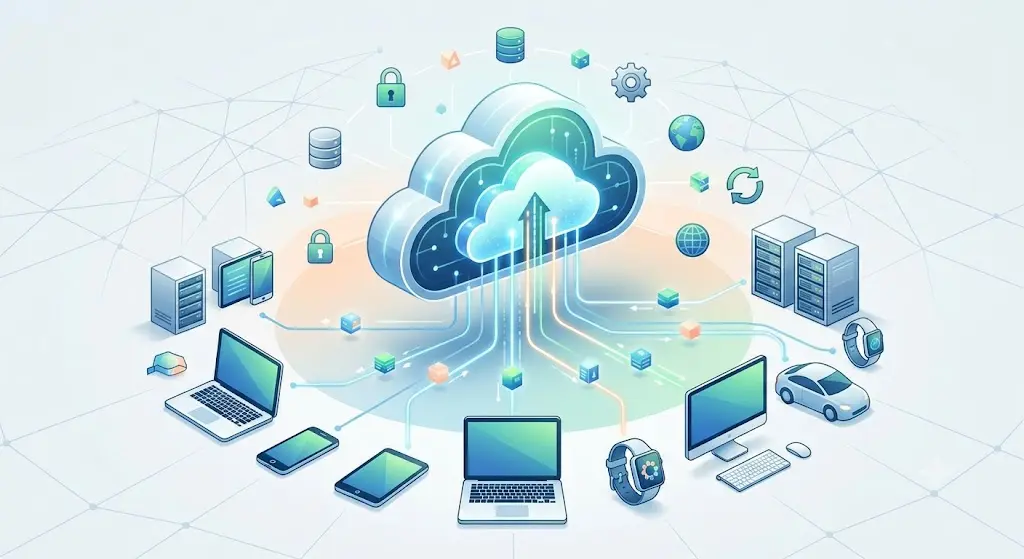
What is cloud computing?It’s the technology that lets you access Gmail, watch Netflix, attend Zoom sessions, and store the photos from your smartphone without having a single server. The size of the cloud computing market currently stands at $591 billion in 2023 and is projected to exceed 1.2 trillion dollars in 2028 with a CAGR of 15.7%.
Cloud infrastructure has taken the form of every business, whether a solo freelancer or a Fortune 500 corporation, operating on it. Knowing how it operates, what model is best suited to your requirements and where the technology is moving next will provide you with a true competitive advantage in any industry that is reliant on digital operations and in 2026 that will be all industries, end of story.
This guide, created by Daily Techify, will take you through each aspect of cloud computing simply and practically starting with the basic definition of cloud computing all the way to the real-world applications of cloud computing, the different models of cloud computing deployment, the types of services and the current trend that has transformed the industry.
What Is the Cloud Computing Definition in Simple Terms?
Cloud computing definition: Cloud computing refers to the provision of computing services including servers, storage, databases, networking, software, analytics and intelligence on a pay as you use basis. Businesses do not need to purchase and maintain physical hardware but instead rent computing power at remote data centers and can use it on any device as long as it is connected to the internet.
The term cloud is based on network diagrams in which engineers conventionally depicted the internet as a cloud form an abstract expression of infrastructure that you utilize however do not need to know or handle. It is precisely that abstraction that is being taken away by cloud computing: the complexity of physical infrastructure has been supplanted with a set of computing resources that are flexible, scalable and on demand.
According to Gartner, cloud computing is a form of computing whereby scalable and elastic IT based capabilities are provided as a service to external customers through internet technologies. Practically, it implies that a startup can get the same computing power as a global company paying by usage, scaled in minutes and can be shut down within minutes as well.
How Does Cloud Computing Technology Actually Work?
Cloud computing technology operates on a global network of data centres, which is enormous physical plants with thousands of servers and storage systems as well as networking equipment that are controlled by the cloud providers on behalf of their customers. When you save a file to Google Drive or spin up an AWS server, you are connecting to physical hardware that is located on average thousands of kilometers away in one of these plants.
Cloud technology is all about flexibility and virtualization is central to it. A software known as a hypervisor splits one physical computer into several virtual machines that are independent and running its own operating systems and applications as though they were physical computers. This virtualization enables cloud providers to effectively and securely serve thousands of customers with the same physical hardware.
The whole system is orchestrated by automation. The cloud management systems observe the utilization of resources, increase capacity in times of peak demand and reduce capacity when demand goes down without the involvement of humans. The elasticity provided by this automation is the key to cloud computing being dramatically different from the on-premises infrastructure that is either idle or is used up at the most inopportune moment.
What Are the Main Types of Cloud Computing Deployments?
The four types of cloud computing can be categorized into four deployment models with each model being specific to a balance between control, security, cost and flexibility. The appropriate model to be selected will be solely based on your workload needs, data sensitivity, compliance needs and budget constraints.
Public Cloud
AWS, Microsoft Azure and Google Cloud are public cloud providers with large shared infrastructure that is used by thousands of customers at the same time. Cloud computing types on the public level are the most cost-effective and scalable ones since infrastructure expenses are dispersed among millions of users. The sheer volume of its scale is the working part of the economics of public clouds: AWS alone brings in more than 90 billion dollars a year and is present in 33 geographic regions worldwide.
Private Cloud
In a private cloud, the infrastructure is dedicated to one organization and is hosted on-premises within the company’s data center or hosted by a third-party provider operating an isolated environment. A private model of cloud computing technology offers the best security and control and is therefore the default option when the bank, defense contractors, healthcare providers and any organization dealing with highly regulated or sensitive data.
Hybrid Cloud
Hybrid cloud integrates both public and private environments, where sensitive workloads can be operated on a private infrastructure, and routine workloads or scalable workloads can be burst into the public cloud. Hybrid deployments of types of cloud computing increased to 73% of enterprise cloud strategies in 2024, as the majority of large organizations desire the flexibility of the public cloud and the control of the private infrastructure.
Multi-Cloud
Multi-cloud strategies place workloads in two or more public clouds at the same time with AWS as the compute cloud, Google Cloud as the AI and analytics cloud, and Azure as the Microsoft-integrated enterprise application cloud. Multi-cloud-based cloud computing solutions eliminate vendor lock-in, earn better cost efficiency with providers, and enhance resiliency by removing dependency on one provider for critical systems.
What Are the Three Core Cloud Computing Services?
The three models of delivery of cloud computing services dictate what is governed by the provider and what is governed by the customer. All cloud products in the market, from Google Docs to Amazon EC2, will belong somewhere in this hierarchy, and knowing it will help you see precisely what you are purchasing and what you are still in charge of.
SaaS — Software as a Service
SaaS provides fully operational applications that are ready to use and do not need to be installed. The SaaS level of cloud computing services consists of Gmail, Salesforce, Microsoft 365, Zoom, Slack and Dropbox. The provider takes care of all the things such as infrastructure, security, updates and maintenance. Users just log in and work. The SaaS industry in the world has attained a market value of 197 billion in 2023 and is projected to increase further at a rate of more than 17% per annum.
PaaS — Platform as a Service
PaaS provides a hosted service in which developers create, test and deploy applications without having to maintain the underlying infrastructure. PaaS-based cloud computing architecture comprises Heroku, Google App Engine and Microsoft Azure App Service. Developers write all the code and the platform takes care of servers, storage, networking and runtime environment and scales automatically.
IaaS — Infrastructure as a Service
IaaS provides bare computing infrastructure, virtual machines, storage, networks and operating systems that IT staff configure and run independently. The IaaS level of cloud computing solutions encompasses AWS EC2, Google Compute Engine and Microsoft Azure Virtual Machines. IaaS offers the greatest control and flexibility and thus is the normative option for organizations with a complex, custom infrastructure need.
SaaS vs PaaS vs IaaS — Quick Comparison
| Feature | SaaS | PaaS | IaaS |
|---|---|---|---|
| Manages | Everything | Platform + infrastructure | Hardware + networking only |
| User Controls | Data & settings only | Code & data | OS, apps, runtime, data |
| Best For | End users & business teams | Developers & engineers | IT teams & DevOps |
| Examples | Gmail, Zoom, Salesforce | Heroku, Azure App Service | AWS EC2, Google Compute Engine |
| Cost Model | Per user/month | Per resource/hour | Per resource/hour |
What Cloud Computing Solutions Work Best for Modern Businesses?
Cloud computing solutions provide businesses with features that could not be matched by on-premises infrastructure with similar budgets. What would have cost a company a physical server infrastructure of $500,000 to achieve can now be achieved using AWS or Azure at a fraction of the cost and scaled up and down as demand varies, instead of making multi-year capacity projections.
Cloud solutions revolutionize disaster recovery. The old business had costly backup secondary data centers; only big companies could afford to maintain such centers. Cloud solutions now provide automatic backup, geographic redundancy and minutes (not days) to recovery time at a cost level that can be afforded by any size business.
Functionalities such as collaboration, which would previously need costly enterprise applications licenses are now a part of cloud computing. Practical applications include Teams on various continents sharing documents, real-time co-editing, project management and communication using infrastructure such as Microsoft 365 and Google Workspace that supports a two-person startup up to a 100,000-employee company on the same platform.
How Does Cloud Computing for Small Businesses Create a Level Playing Field?
Cloud computing for small businesses removes the infrastructure cost difference that created an unjust technology edge to large enterprises in the past. A three-person startup now enjoys the same AWS infrastructure, the same Salesforce CRM and the same Google Workspace tools that large corporations use at a cost of only what they actually use instead of the cost of owning expensive hardware that is under-utilized most of the time.
Software such as QuickBooks online, project management software such as Asana, and customer support software such as Zendesk are all cloud-based SaaS applications that can be accessed by small businesses at a monthly subscription fee that is less than one server purchase. According to a Gartner study, small business enterprises that operate on cloud infrastructure experience an average 19.6% point higher growth in revenues compared to those operating on on-premises solutions.
Small business cloud computing also provides security features that small IT departments had never been able to develop. Cloud providers have full-time security staff, achieve compliance accreditation under dozens of international regulations and have 24/7 system visibility which would cost a small business millions to do internally.
What Are the Real Advantages and Disadvantages of Cloud Computing?
Any technology has its trade-offs and cloud computing is not an exception. Having knowledge on both sides of the equation will result in more successful adoption choices and prevent the implementation setbacks that transform cost-saving efforts into a costly fiasco.
Advantages of Cloud Computing
Advantages and disadvantages of cloud computing start on the positive side with cost efficiency. Business cuts capital spending on hardware, maintenance overheads and switches IT costs to variable incurring only the costs of capacity utilized. According to McKinsey research findings, organizations can save IT infrastructure costs by 30-40% within the first year of migration to the cloud.
The second significant benefit is scalability. Cloud systems have the capability of scaling computing resources up or down within minutes which is critical to businesses with seasonal demand or product rollouts or with unforeseen growth. During peak evening times, Netflix scales its streaming infrastructure by 800% and scales down before the morning without acquiring a single new physical server.
The list of advantages includes global coverage, automatic updates to software, in-built disaster recovery and the availability of advanced AI and analytics solutions which cloud platforms offer as part of their regular features, instead of costly bells and whistles.
Disadvantages of Cloud Computing
Internet addiction poses a real weakness. Cloud applications also demand a good connection and an outage of the internet halts access to data and tools that the on-premises systems would continue to operate without the failure. The actual operational risk that businesses in places with unreliable connectivity experience is mitigated by the hybrid or on-premises models.
Recurring subscription fees are very costly in the long-term. When a business fully transitions to cloud SaaS tools, it can usually find total software spending more than any on-premises licensing spending in three to five years as subscription fees accumulate at both the tool, user and usage levels.
The third challenge is data sovereignty and the complexity of compliance. The presence of sensitive customer data on cloud servers in more than one country will activate the data residency rules in the EU, UK and increasingly in the US compliance requirements that make cloud architecture choices before any data migration occurs.
What Are the Best Real-World Cloud Computing Examples in 2026?
Cloud computing examples can be found in any digital tool that millions of people use day-to-day and may be unaware of the cloud platform that the platform is built on. The eight examples demonstrate precisely how cloud technology works in industries and applications.
The Google Drive is a cloud-based storage and synchronization platform that enables users to store and access files on all the devices they possess on the global cloud platform of Google. Globally, Google Workspace is the most popular productivity cloud platform with over 3 billion users.
Netflix operates on AWS cloud computing, streaming to a current of 250 million subscribers at a time serving 190 countries. Netflix takes advantage of AWS to increase capacity during peak times and decrease it at night, a flexibility that physical data centers could never afford at this price.
During peak pandemic demand in 2020, Zoom provided video conferencing to more than 300 million daily meeting attendees by dynamically scaling cloud infrastructure in days an expansion that would otherwise have taken years to achieve using physical servers.
Amazon Web Services (AWS) supports an estimated 31% of the worldwide market in cloud infrastructure and provides millions of companies, such as NASA Jet Propulsion Laboratory, Airbnb and Pinterest with shared cloud infrastructure with its own performance and security.
Offering Word, Excel, Outlook, Teams and SharePoint as cloud SaaS services to its 400 million paid seats worldwide, Microsoft 365 replaces the days of boxed software with persistent automatic updates and real-time collaboration on all devices.
Salesforce is the first enterprise SaaS CRM and currently serves more than 150,000 business clients with a cloud infrastructure that processes 233 billion transactions daily – showing the data size that cloud architecture can handle in practice in production.
The foundation of the entire business of Dropbox is cloud file storage, which caters to more than 700 million registered users without having to own the storage powering it all which is built on AWS cloud object storage which automatically scales with the demand of its users.
Spotify plays 100 million songs and podcasts each day to 600 million users on Google Cloud Platform infrastructure that makes personalized recommendations, handles licensing data and fulfills streaming requests on all the continents at the same time.
What Cloud Computing Trends Reshape the Industry in 2026 and Beyond?
Cloud computing trends in 2026 will be toward smarter, leaner and more distributed cloud infrastructure that brings computing nearer to the source of data instead of concentrating everything in remote data centers. Knowledge of such trends can help businesses make decisions of adoption that will not become outdated after five months but after five years.
AI-Driven Cloud Infrastructure
The trends in AI infrastructure and cloud computing control the 2026 investment. All large cloud providers now have GPU clusters, AI training pipelines and pre-built machine learning services that businesses can now access without the need to own dedicated hardware. Azure AI at Microsoft, AWS SageMaker and Google Vertex AI all democratize the ML development enabling organizations to create AI applications that previously took teams of PhD researchers and tens of millions of dollars of infrastructure investment to build.
Multi-Cloud and Hybrid Strategies
The use of multi-cloud is gaining momentum because organizations are finding that outages by single providers that have brought down large platforms in 2023 and 2024 teach valuable lessons. The cloud computing architecture established with many providers attains redundancy unattainable by a single provider. Multi-cloud environments are already deployed by 87% of enterprises and that number is growing as cross-provider deployment is becoming increasingly straightforward with cloud-native development tools.
Cloud Cost Optimization Through FinOps
According to most organizations, cloud spend increased more quickly than anticipated between 2020 and 2024, which led to the establishment of a FinOps field that aims at maximizing cloud ROI by continuously monitoring and optimizing costs. Cloud computing solutions native cost management features are now available in every major cloud computing provider and third-party FinOps solutions such as CloudHealth and Apptio can assist organizations to remove the cloud waste, which Gartner estimates costs 30% of overall cloud spending at enterprises.
Edge Computing Growth
Edge computing brings processing nearer to the source of data, i.e., factories, vehicles, retail stores and smart devices, instead of sending all data to remote cloud data centres. Cloud computing technology at the edge reduces latency for time-sensitive applications like autonomous vehicles, industrial automation and real-time healthcare monitoring. The global market of edge computing is projected to expand to about 232 billion dollars by 2030 after its current market size of 61 billion dollars in 2023.
Conclusion: Why Cloud Computing Is the Foundation of Modern Business
The bottom line of what is cloud computing is all about: it is the framework that enables contemporary digital business of any scale. Whether a freelancer tapping into Google Docs or a multinational corporation with millions of transactions per day running on AWS, the computing power, flexibility and reliability that any digital operation has grown to rely upon are being provided by cloud computing.
The technology keeps moving fast, the integration of AI, deployment of edges, multi-cloud orchestration and optimization of FinOps all transform the cloud landscape in 2026 in a manner that presents new opportunities to all organizations that are ready to approach them in a strategic not reactive manner.
Daily Techify recommends that all readers considering cloud adoption consider a clear definition of workload, the data sensitivity requirements and the long-term cost model before choosing a provider or deployment model. The correct cloud strategy enables the business to grow quickly the incorrect one causes technical debt that requires years to clean up.
FAQs
What is cloud computing in simple words?
In a basic definition, cloud computing is the process of leasing computing power, storage and software via the internet as opposed to purchasing and maintaining physical hardware. You can use it on any device, pay only when you have to use it, and the infrastructure is maintained by the provider.
What are the main types of cloud computing?
The cloud computing types can be divided into four primary deployment models: public cloud (providers such as AWS and Azure share infrastructure), private cloud (dedicated infrastructure to an organization), hybrid cloud (a combination of both) and multi-cloud (an organization uses multiple providers at the same time to achieve resilience and cost efficiency).
What is the difference between SaaS, PaaS, and IaaS?
SaaS provides ready to use software applications such as Gmail or Salesforce. PaaS provides a controlled development system through which engineers develop and deploy code without operating servers. IaaS provides bare virtual infrastructure servers, storage and networks that IT departments set up to be as customizable as possible.
Is cloud computing good for small businesses?
Small business cloud computing provides business-grade solutions with startup pricing. Small businesses are on the same AWS platform, CRM systems, and collaboration tools as multinational corporations having to pay subscription fees in the form of monthly fees rather than six figure initial hardware expenditures and Gartner data indicates that cloud adopters experience 19.6% higher revenue growth.
What are the main advantages and disadvantages of cloud computing?
Benefits and drawbacks of cloud computing: among the main benefits are the reduction of costs (30-40% infrastructure savings), unlimited scalability, global access and automatic updates. The main drawbacks are that it is addictive, expensive in the long-term in terms of the build-up of subscriptions and businesses with operations in different countries have a complex compliance with data sovereignty.