Introduction
One of the most popular discussions among businesses that are heading to digital transformation is private cloud vs public cloud. All organizations desire to have enhanced security, reduced expenses, faster service and increased flexibility but selecting the appropriate cloud deployment model can be overwhelming. The choice has an impact on your infrastructure, scalability, compliance and IT spending over time.
The State of the Cloud Report by Flexera indicates that over 89% of enterprises are now implementing a multi-cloud strategy, with almost 73% of them having a hybrid cloud environment. These figures demonstrate one significant aspect: there is no universal cloud solution that will suit any business.
Regardless of being a startup, a growing organization, or a multinational organization, being aware of the distinctions between a public, a private, and a hybrid cloud model can enable you to make wiser technology investments. Daily Techify presents all deployment models in this guide, contrasts their advantages and guides you in finding out which model fits your business objectives.
Quick Comparison Table
| Feature | Public Cloud | Private Cloud | Hybrid Cloud |
|---|---|---|---|
| Cost | Low upfront cost | Higher investment | Moderate |
| Security | High | Very High | Very High |
| Scalability | Excellent | Moderate | Excellent |
| Control | Limited | Complete | High |
| Maintenance | Cloud provider | Organization | Shared |
| Performance | Excellent | Dedicated resources | Optimized |
| Best For | Startups & SMBs | Healthcare, Finance | Growing Enterprises |
What Is a Public Cloud?
What is a public cloud? A public cloud is a cloud computing platform in which computing resources are provided by third-party providers via the internet. There are several businesses that are on the same infrastructure and high-end virtualization technology ensures their data is isolated and secure.
Companies lease servers, storage, networking, databases and software as needed, instead of making costly hardware purchases. This model enables the organizations to save capital expenditures whilst obtaining the enterprise-level infrastructure which is known as pay-as-you-go.
Businesses usually opt to use the services of the public cloud as it can be deployed in just a few minutes as opposed to weeks. The teams are able to add resources immediately when traffic is on the rise or new projects emerge.
Benefits of Public Cloud
The benefits of public cloud have many more benefits than affordability. Without physical infrastructure, organizations become flexible, fast and have access to the best technologies.
Some major advantages include:
- Reduced initial infrastructure expenses.
- Infinite capacity to support increased workloads.
- Fast deployment of applications
- Automatic software updates
- Global accessibility
- Disaster recovery and high availability options.
- Intrinsic AI, analytics, and machine learning services.
These benefits enable quicker innovation and less IT management burden for many startups.
Real-World Examples of Public Cloud
When discussing public cloud vs private cloud vs hybrid cloud, major cloud providers are often a starting point. These companies operate millions of servers in data centers worldwide.
The most popular public cloud platforms are:
- Amazon Web Services (AWS)
- Microsoft Azure
- Google Cloud Platform (GCP)
The services provided by these providers cover hundreds of cloud services, such as virtual machines, storage, databases, artificial intelligence, networking, cybersecurity and application hosting.
As an example, an online shopping site can automatically increase the number of servers during holiday sales and decrease the number of servers once the demand decreases. This elasticity assists businesses in saving money on the unused resources.
What Is a Private Cloud?
What is a private cloud? A dedicated cloud is a private cloud that is operated by one organization. No other business shares its computing resources as would be the case with public cloud infrastructure.
Businesses can maintain their own clouds within their own data centers or with dedicated cloud vendors. In either case, they have more control over infrastructure, security policies and compliance requirements.
Companies that manage sensitive financial data, medical data, government data, or intellectual property tend to use a private cloud environment due to the need to have more intense governance and security measures.
Companies that manage sensitive financial data, medical data, government data, or intellectual property tend to use a private cloud environment due to the need to have more intense governance and security measures.
There is also the aspect of customization of networking, storage,and computing resources by the business using their operational needs through the use of private clouds rather than the standardized infrastructure of the public cloud.
Benefits of Private Cloud
The benefits of private cloud make it a better option for organizations that have stringent security and compliance needs.
Key advantages include:
- Dedicated infrastructure
- Greater data privacy
- Strong regulatory compliance
- Better customization
- Consistent application performance
- Enhanced access controls
- Improved workload management
However, it is true that though the investments in private cloud environments are more they offer more control of operations in the mission-critical applications.
Who Should Use Private Cloud?
The choice between a private cloud vs public cloud is usually determined by industry demands and not necessarily by budget.
The most suitable cloud type is the private cloud, which is applicable in:
- Financial institutions
- Healthcare organizations
- Government agencies
- Defense contractors
- Insurance companies
- Large enterprises
- Companies dealing with sensitive customer data.
Such industries are obliged to adhere to stringent laws and to ensure that the confidential information is not exposed to changing cyber security risks.
What Is a Hybrid Cloud?
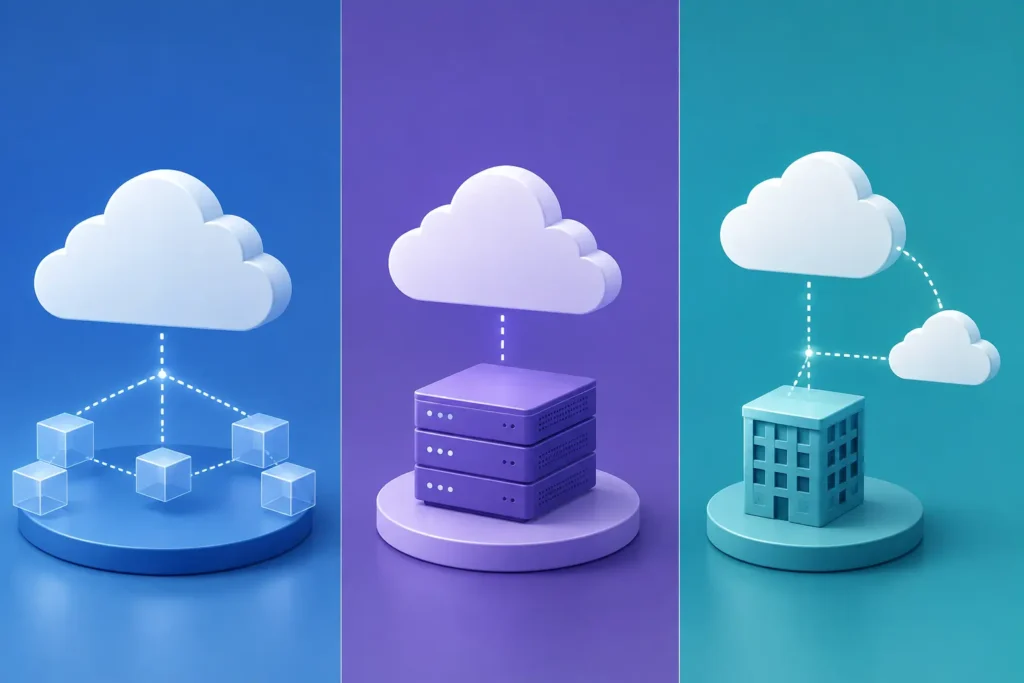
What is a hybrid cloud? A hybrid cloud is the integration of a public cloud and a private cloud platform that enables companies to transfer workloads and data across the two environments. This model provides organizations the option to store sensitive information in a private cloud and apply the public cloud to applications that need scalability and cost effectiveness.
Businesses can have the best features of both environments, rather than depending on one deployment model. They are able to have a high level of security for the confidential data and utilize on-demand computing power when it is most needed.
A hybrid cloud is favored by many organizations since it helps them to achieve digital transformation without displacing their current infrastructure. This is also a way of making cloud migration easy as businesses can move according to their own pace.
Benefits of Hybrid Cloud
The benefits of hybrid cloud make it one of the most rapidly growing models of cloud deployment in any industry. Businesses enhance effectiveness, efficiency and business continuity without losing flexibility.
The largest benefits are:
- Greater workload flexibility
- Better disaster recovery
- Enhanced business continuity
- Improved cost optimization
- Good protection of confidential information.
- Faster application deployment
- Scales easily when there is traffic.
- Easy interconnectivity with other systems.
According to industry reports, organizations that employ a hybrid cloud strategy tend to save on the cost of infrastructure, in addition to enhancing the availability of applications and efficiency in operations.
Real-World Examples of Hybrid Cloud
The comparison between a public cloud vs a private cloud vs hybrid cloud is easier to comprehend using real-life situations.
A hospital can have confidential patient records in a private cloud to comply with healthcare regulations and operate appointment scheduling and patient portals on the public cloud.
A customer database can be stored in a private cloud by a retail company but be deployed on the resources of a public cloud during the Black Friday sales to serve millions of online customers.
Banks typically handle sensitive financial transactions on private infrastructure and use public cloud services to detect fraud, analytics and support apps.
These illustrations explain why hybrid cloud remains a popular type of cloud among contemporary businesses.
Private Cloud vs Public Cloud: Key Differences
The differences between private cloud vs public cloud are in various key aspects like cost, security, control and scalability. These differences can guide businesses to choose the appropriate deployment model to meet their business requirements.
| Feature | Public Cloud | Private Cloud |
|---|---|---|
| Ownership | Third-party provider | Single organization |
| Infrastructure | Shared | Dedicated |
| Initial Cost | Lower | Higher |
| Monthly Cost | Pay-as-you-go | Predictable but higher |
| Security | Strong | Maximum |
| Compliance | Standard | Highly customizable |
| Maintenance | Provider manages | Organization manages |
| Scalability | Nearly unlimited | Limited by infrastructure |
| Customization | Moderate | Extensive |
| Best For | Startups and SMBs | Large regulated organizations |
Public cloud is cheap and highly scalable, whereas the private cloud is as controlled as possible and more compliant. Before making a decision, businesses have to consider their security needs, budget and long-term growth.
Hybrid Cloud vs Multi-Cloud: What’s the Difference?
Hybrid cloud and multi-cloud are terms that are used interchangeably by many businesses yet they address different issues.
A hybrid cloud links both the public and the private cloud infrastructures in order to allow workloads to freely move between the two.
A multi-cloud strategy involves a combination of services provided by two or more cloud providers that are public but may not involve integration of own infrastructure.
For example:
- An organization that employs both AWS and Microsoft Azure is a multi-cloud company.
- A company that is integrating Microsoft Azure with its own data center is adhering to a hybrid cloud approach.
Hybrid cloud is more integration and flexibility oriented, and multi-cloud is more provider oriented and risk reduction.
Which Cloud Model Is Right for Your Business?
There are different business objectives of cloud deployment models. The selection of the appropriate option varies according to the size of the company, compliance needs, demands of work and budget at hand.
Choose Public Cloud If:
- You are a start-up or small business.
- You require high scalability.
- You desire reduced infrastructure prices.
- Your workloads are frequently changing.
- You have limited IT resources.
Choose Private Cloud If:
- You deal with very secretive data.
- There are strict compliance rules that you have to adhere to.
- You need full infrastructure management.
- Your company must have tailored security policies.
- Consistency in performance is imperative
Choose Hybrid Cloud If:
- You want both flexibility and security.
- There are seasonal peaks in your business.
- You intend to upgrade the current infrastructure.
- You need to balance cost and compliance.
- Departments differ in their workloads.
The choice of the appropriate cloud model must be made with consideration of the present and future business needs. An appropriate deployment strategy can be invested in today to lower costs of operations and enhance scalability in the long-term.
Cloud Deployment Models — Cost Comparison
Cloud cost is more than just the price per month. Companies must also consider maintenance costs, employee needs, investments in hardware and scalability in the future.
| Cost Factor | Public Cloud | Private Cloud | Hybrid Cloud |
|---|---|---|---|
| Initial Investment | Low | High | Medium |
| Hardware Purchase | No | Yes | Partial |
| IT Maintenance | Low | High | Medium |
| Scalability Cost | Flexible | Fixed | Flexible |
| Long-Term Savings | High for SMBs | High for Large Enterprises | Balanced |
Even though the entry cost in public cloud is the lowest, with predictable workloads, organizations can have higher long-term value when using private infrastructure. Hybrid cloud offers a very good balance as it gives business the opportunity to optimize costs based on various workloads.
Conclusion
There is no such thing as a private cloud vs public cloud, it is a matter of which deployment model fits your business goals in the best way. Public cloud offers low costs and scalability, private cloud offers unmatched security and control and hybrid cloud offers the benefits of both environments to achieve maximum flexibility.
With the continued evolution of cloud computing, those organisations that align their infrastructure with their business objectives will enjoy efficiency, better security and stay competitive in a world that is getting more digital. Assess your workloads, compliance requirements as well as growth strategies before making your choice.
If you are starting your first cloud project on the first day or you are modernizing an enterprise infrastructure, you will always be informed with guides to technology and practical knowledge in Daily Techify. Learn more on our resources in order to make smarter choices about cloud computing and to future-proof your business.
Frequently Asked Questions
Is a hybrid cloud more costly than a public cloud?
There can be a little more cost involved in implementing hybrid cloud since businesses operate in two settings, the public and the private. But it tends to save operational costs in the long-term as the workloads are located where they are most effective.
Is it possible to convert a public to a private cloud?
Yes. To scale up security, compliance or performance needs many organizations start with public cloud services and subsequently move critical workloads to a private infrastructure.
What is the safest type of cloud model?
Security is usually the most important in the case of a private cloud since companies have full access to infrastructure, access control policies and data control. Hybrid cloud also provides excellent security when companies retain sensitive data in closed systems.
Do small businesses need private clouds?
The public cloud services are more advantageous to most small businesses as they are cheaper, simpler to manage, and very scalable. The value of the private cloud is when the enterprises have to fulfill strict regulations or security demands.