The past two years have seen marketing teams discussing AI as a single tool. It isn’t. Generative AI composes your advertising text. Autonomous campaign workflows are run by agentic AI. And below either of those, and performing the less flashy, less glamorous task of predicting, scoring, and ranking, is machine learning the technology which in actuality selects who views your ad, who receives a product recommendation, and which email subject line passes the A/B test.
At least one of the recurring workflows that marketers use generative AI increased by percentage in the high 80s in 2024 to the high 80s in 2026 ( Salesforce State of Marketing research ). Generative AI is the visible layer though. Machine learning is the motor behind it and it is developing in ways that have very little to do with the chatbots writing blog posts.
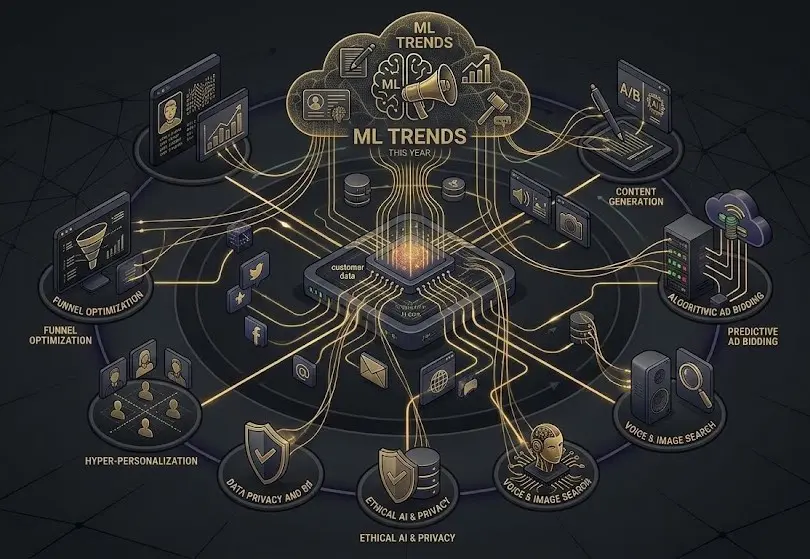
This paper divides five machine learning-based trends that are in fact transforming digital marketing this year, not trend articles of the sort, but the machine learning techniques used to drive the digital marketing of predictive analytics, hyper-personalization, programmatic bidding, conversational marketing, and AI-era SEO. Every part has a real-life example, up-to-date data, and an entry point in case you wish to take action about it.
What Is Machine Learning in Digital Marketing? (And How Is It Different From AI?)
Machine learning is a branch of artificial intelligence whereby a system develops patterns based on the given data and makes better predictions as time goes by without necessarily being rewritten to fit a new situation. In marketing, that implies that a trained ML model of previous purchasing behavior can make predictions to identify which customers will be likely to churn, the most effective ad creative to use with a particular group of customers, or which product a shopper will most likely purchase next.
The umbrella is named “AI.” Within that umbrella are a few of those technologies that marketers are likely to group together:
| Technology | What it actually does | Common marketing use |
|---|---|---|
| Machine learning | Learns patterns from historical data to predict outcomes | Churn prediction, lead scoring, recommendation engines, bid optimization |
| Generative AI | Creates new text, images, or video from learned patterns | Ad copy, blog drafts, image variations |
| Agentic AI | Chains multiple AI capabilities together to complete multi-step tasks autonomously | End-to-end campaign management, automated reporting, self-management of bids |
| Natural language processing (NLP) | A branch of ML focused on understanding and generating human language | Chatbots, sentiment analysis, voice search |
Such a distinction is important as it shifts the way you consider tools and where you put money. A generative AI service writes your newsletter. The machine learning algorithm will decide which 20% of your list is really opening it. Both are very important, but both address different problems.
Trend 1: Predictive Analytics for Customer Behavior
Predictive analytics is the ability to predict customer behavior based on historical data, such as purchase history, browsing behavior, support tickets, email engagement. Three of the most popular marketing uses are churn prediction (who will leave), propensity scoring (who will buy) and customer lifetime value modeling (who is worth the most to keep).
This is not a new concept, but models supporting this concept have become much more precise and accessible. The recommendation and retention engine at Netflix, which is nearly solely based on predictive modeling of viewing behavior, has been reported to save the company about 1 billion dollars a year in churn. The model does not merely propose a show, but instead predicts the type of thumbnail image, preview clip, and position of the row that will ensure a particular subscriber will not cancel.
To the majority of the businesses, the entry mode is less glamorous but operates on the same principle: a customer data platform (CDP) driving a predictive scoring system to identify at-risk accounts before they churn, or high-propensity leads before a rival takes them first.
How to begin: Predictive scoring is already included as a feature in most marketing automation platforms (HubSpot, Salesforce Marketing Cloud, Klaviyo). It is often the default setting in your existing CRM and so it is necessary to check before purchasing a separate ML platform that it has this turned off.
Trend 2: Hyper-Personalization at Scale
Personalization was to put a first name in a subject line of an email. Machine learning has made it more of a one to one storefront: product suggestions, page designs, search results, and even pricing that is adjusted based on recommendations engine algorithms trained on millions of behavioral data points.
The algorithm is typically a form of collaborative filtering (recommend what other users who are similar liked) or content-based filtering (recommend what is similar to what this user already read). The most obvious consumer-facing variants are Spotify’s Discover Weekly and Amazon’s “customers also bought” panel, but the same templates are now silently operating in online search engines, onsite chatbots, and dynamic homepages.
Mckinsey Global AI Survey research, has found that personalization engines based on AI and machine learning are said to require nearly a 2.7x payback on the marketing investment they are driven by – one of the best ROI functions of AI-supported marketing functions.
The trap: the issue of personalization fatigue does exist. When personalized is in fact creepy, especially in pricing or retargeting that feels like spying, customers will be aware of it. The brands that are doing this correctly are clear on why they are presenting someone with an offer, not just maximizing on click-through.
Starting point: Choose one platform, onsite recommendations, post-purchase email campaigns, or browse abandonment, rather than trying to personalize everything at once. Recommendation systems that work on most e-commerce platforms such as Shopify and BigCommerce are inbuilt or plug-in models and hence no custom model building is required.
Trend 3: Machine Learning in Programmatic Advertising and Bidding
Programmatic advertisement has emerged unobtrusively as one of the most ML-infested marketing spheres. The Real-time bidding (RTB) systems analyse an ad impression, estimate the likelihood of a particular user to convert, and determine the amount to bid; all within a few seconds or so, the time required to load a webpage.
The paid acquisition strategy of Airbnb is one of the most often mentioned examples of it in practice: the company has shifted the funds to AI-based bidding and predictive attribution models instead of general marketing campaigns that focus on the brand, which the company has attributed to saving unnecessary advertising expenses and increasing the efficiency of the acquisition process.
This is supported by the bigger data. In a survey of enterprise AI deployments in sales and marketing stack, published in 2026 by McKinsey, companies who had deep, enterprise-wide deployments of AI and ML in sales and marketing reported average sales ROI improvements in the 1020 percent range, with the largest improvements being in industries with large historical datasets to train on, such as financial services and retail.
The weakness that should be named is that these models are as effective as the information that is used to fuel them. As third-party cookies keep dwindling and privacy laws keep getting stricter, those businesses that benefit most of all in ML-driven bidding are those that already invested in clean first-party data pipelines. Otherwise, the model is maximizing incomplete information.
How to begin: Audit the extent to which your current ad performance data is first or third-party. When it is largely third-party, then it is the real blocker, not the algorithm of bidding.
Trend 4: Conversational AI and NLP-Driven Marketing
Most of what is referred to as AI chat is now powered by natural language processing, the subfield of machine learning that deals with processing and producing human language. Sentiment review models scan reviews and social mentions to identify any changes in brand perception before it goes critical. Conversational AI is a real-time product discovery, FAQ, and lead qualification technology that does not require a human in the loop.
The example of AI-assisted chat assistance in product discovery that was launched by H&M is often cited: the faster response to the query was directly translated into a better engagement and higher online purchase conversion, according to the reports about the implementation.
This same umbrella is technically applicable to voice and visual search (visual search uses computer vision instead of language models although they are often used together in product discovery tools). Its overlaying strand is the same: the customers are more and more demanding instantaneous, precise, conversational answer, and brands that cannot provide it are structurally disadvantaged on the response-time level alone.
How to begin: Begin small. A chatbot that is trained on the 20 most popular questions in your site will be more helpful than a general, undirected one, and most platforms (Intercom, Drift, even native ecommerce chat applications) allow you to focus training information narrowly before going wide.
Trend 5: Machine Learning for SEO and AI Search Visibility
Machine learning has long been applied in ranking signals by search engines, but with the transition to AI-generated search summaries, what this ranking is optimizing has changed. Modern ranking systems, rather than matching keyword density, are based on ML models that learn to identify entities, gauge topical authority, and consider experience and trust indicators the principles that search engines currently term as E-E-A-T ( Experience, Expertise, Authoritativeness, Trustworthiness ).
In practice, it translates to organized information, well-defined entity relationships (who wrote this, what is their real experience, what are the sources of this statement, etc.), and content depth are even more crucial than it was just two years ago. Even as AI Overviews and conversational search interfaces are gaining, Google still retains the vast majority of search market share worldwide as per widely-referenced market share tracking, so this is no narrative about traditional search being phased out. It is a tale of how this ranking layer below it gets wiser in regard to what is a good answer.
How to begin: Review your already existing high-quality content to have structured data (schema markup), clear authorship and credentials, and original data or examples instead of re-worded aggregator content. That is the particular gap that most competitor material in this space continues to leave open.
Machine Learning Marketing Statistics at a Glance
| Statistic | Source |
|---|---|
| Generative AI workflow adoption among marketers rose from ~51% in 2024 to ~87% in 2026 | Salesforce State of Marketing 2026 |
| AI-driven personalization engines report roughly 2.7x ROI on average | McKinsey Global AI Survey |
| Enterprise-wide AI/ML deployment correlates with 10–20% average sales ROI improvement | McKinsey Global Survey, 2026 |
| Less than 25% to 33% of companies have taken their marketing efforts using AI/ML beyond the pilot phase | Gartner AI Adoption Benchmark Report, 2026 |
| Half of all companies implementing AI for their marketing efforts find these efforts profitable; the other half are able to recover their costs | Forrester State of AI in Marketing, 2026 |
| The machine learning market is in the tens of billions of dollars in 2026, with projected growth rates between 25% and 30% CAGR through the early 2030s | Fortune Business Insights / AIMultiple |
| AI-driven marketing analytics adoption rose from ~31% in 2024 to ~56% in 2026 | Improvado Marketing Analytics Trends, 2026 |
| Average AI marketing investment now reaches profitability in just over a year, down from nearly two years previously | Deloitte AI ROI Maturity Index, 2026 |
(Publicly reported industry research, paraphrased and rounded, was used to derive the figures above). Make direct reference to each named source when you are using them in your own published version.)
The Risks and Limits of Machine Learning in Marketing
This will not work as well as the case studies would indicate when the underlying data is messy, biased or thin. A predictive model which has been trained on a small or biased set of customers will be sure to make bad predictions – it just will not inform you that they are bad. Excessive personalization, especially on pricing or frequency of retargeting are also prone to corrosion more rapidly than conversion, and customers are becoming knowledgeable enough to detect when the so-called personalization becomes so-called surveilled.
The gap between adoption and outcome is also noteworthy: According to the study conducted by Gartner, a significant portion of companies remain at the pilot phase instead of the scaled implementation, which is often caused by the lack of cohesive data infrastructure and in-house ML knowledge, as opposed to the insufficiency of the technology itself. Use it as an input in your plan, not an excuse to delay–the companies that make it through first have a tendency to maintain the lead.
How to Prepare Your Marketing Stack for These Trends
- Audit your data and then audit your tools. The vast majority of the underperformance of most ML is due to the failure to complete or silo first-party data, rather than the failure to model it.
- Use one to pilot, not five. A six-to-eight-week pilot would be a realistic predictive churn scoring or a single recommendation surface. Attempting to make each channel personal simultaneously isn’t.
- Human in the loop. Retargeting frequency, especially in pricing, anything that touches the customer and the model can look optimized, which might be interpreted as off-brand or invasive.
- Measure first, scale afterwards. Establish a definite pre/post measure (churn rate, conversion rate, CAC) prior to rolling a pilot out across a company.
FAQs
Is it not the same as machine learning in marketing as AI?
Yes. The larger category is AI; machine learning is a particular method of it that learns patterns based on data to make predictions, unlike generative AI (which generates content) and agentic AI (which links tasks together on its own).
Which is the least difficult machine learning trend that a small business can follow?
Predictive lead scoring or simple product recommendations, as most CRM and ecommerce systems natively support such features instead of having to develop custom models.
Do you think machine learning will be able to take over marketing?
It is automating certain functions – scoring, bidding, rudimentary personalization – not whole functions. The shift in demand is not against marketing as a profession, but to marketers capable of interpreting the model output and making strategic decisions.
What is the cost of entering into an ML use in a marketing campaign?
To the majority of small and mid-sized businesses, the practical starting price is near to none beyond what you are presently paying in martech subscription, as predictive scoring and recommendation services are becoming part of the platforms to which you are probably already subscribed.
Is predictive analytics valuable to small businesses?
Yes in general when retention-oriented applications such as churn prediction, and a small increase in the ability to identify at-risk customers early will tend to justify the tooling. It is less obviously worth it to businesses that do not have sufficient historical data to train a model on thus far.
Final Thought
The ones that are moving faster this year are not the ones that are embracing the most AI tools, but the ones that realize what particular machine learning method is solving what particular problem, and who are transparent about where the data is not yet ready to backup it. Begin with a single model, use case, and definite metric, and work upwards.