Introduction
As more and more companies focus on improving their customers’ experience, the terminology like chatbots and conversational AI is commonly used to describe it. They are however not identical technology. Although they both assist organizations in automating interactions and enhancing customer interaction, they vary massively in terms of intelligence, capabilities, and influence on businesses.
Indeed, research indicates that more than half of all consumers favor direct and automated customer service in cases of straightforward questions, and companies implementing customer service through the use of AI report significant decrease in their response time and costs of providing assistance.
Differentiation between chatbots and conversational AI is important in choosing the right approach for your company. The following guide will tell you about the characteristics, pros and cons of each technology and its possible future.
What Is a Chatbot?
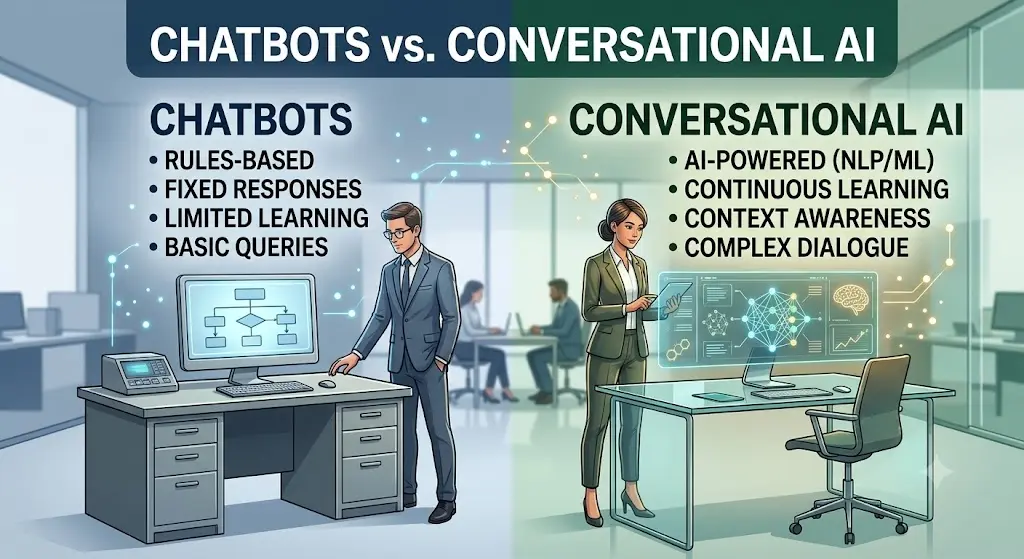
Chatbots are applications running on computers simulating conversation with the user by using text or voice input. Classical chatbots are based on rules and make use of decision trees and preprogrammed answers for certain inquiries.
Important Characteristics of Chatbots
- Rule-based interactions
- Predefined conversation flows
- Commonly used support questions
- Appointment scheduling
- Order tracking
- Simple customer care robotization
Common Chatbot Examples
- Website support bots
- FAQ assistants
- Booking assistants
- Bots to track orders in e-commerce
Benefits of Chatbots
- Fast implementation
- Lower development costs
- Reduced support workload
- 24/7 availability
Limitations of Chatbots
- Poor knowledge of the user intent.
- Lack of ability to deal with elaborate requests.
- Deficiency in situational knowledge.
- Lack of flexibility to unforeseen questions.
What Is Conversational AI?
One of the advanced technologies making the interaction between the computer and human being through voice possible is conversational AI. The components of conversational AI consist of natural language processing, natural language understanding, machine learning, and large language model that facilitate interaction.
As opposed to chatbots, conversational AI takes into account the context of responses.
Conversational AI Technologies
- Natural Language Processing (NLP)
- Machine Learning
- Natural Language Understanding (NLU)
- Speech Recognition
- Large Language Models (LLM)
- Generative AI
Benefits of Conversational AI
- Human-like conversations
- Context retention
- Personalized experiences
- Continuous learning
- Omnichannel support
- Improved customer satisfaction
Real-World Applications
- AI customer support
- Virtual assistants
- Sales automation
- Healthcare support
- Financial services assistance
Chatbots versus Conversational AI: Quick Comparison
| Feature | Chatbots | Conversational AI |
|---|---|---|
| Response Method | Rules-Based | AI-Powered |
| Learning Capability | Limited | Continuous Learning |
| Context Awareness | Minimal | Advanced |
| Personalization | Basic | Highly Personalized |
| Complex Queries | Limited | Excellent |
| NLP Support | Basic | Advanced |
| Voice Interaction | Limited | Strong |
| Customer Experience | Functional | Human-Like |
| Scalability | Moderate | High |
| Long-Term ROI | Moderate | High |
10 Differences between Chatbots and Conversational AI
1. Intelligence Level
Scripts form the foundation for chatbots while conversational AI can understand the intent behind the conversation and can adapt itself accordingly.
2. Context Awareness
Conversational AI remembers previous conversations and applies the context in making the conversation better.
3. Learning Capabilities
Updating conventional chatbots needs to be done manually. Machine Learning is a continuous process which can be used to improve conversational AI.
4. Personalization
Conversational AI gives personal recommendations depending upon user behavior.
5. Natural Language Understanding
Conversational AI understands various sentence structures and the slang involved in the conversation.
6. Multi-Turn Conversations
High-level AI technology can sustain coherent conversations within a number of exchanges.
7. Omnichannel Support
The Conversational AI technology may be applied not just to websites but to mobile apps, social media, and even voice assistants.
8. Voice Capabilities
The voice assistants are highly based on conversational AI technologies.
9. Customer Satisfaction
Intelligent interactions can help businesses to gain more satisfaction.
10. ROI
The deployment cost of conversational AI is higher compared to chatbots; however, it will ensure greater efficiency in the long term.
Chatbots vs Conversational AI Technology Stack
Understanding the technology behind each technology helps companies make the right decision
Chatbot Technology
- Rule engines
- Decision trees
- Keyword matching
- Basic automation workflows
Conversational AI Technology
- NLP
- NLU
- Machine learning algorithms
- Large language models
- Generative AI
- Sentiment analysis
Real-World Examples
Chatbot Examples
- Appointment booking systems
- FAQ bots
- Shipping updates
- Customer inquiry routing
Conversational AI Examples
- AI-powered support assistants
- Banking virtual agents
- Healthcare symptom assistants
- Intelligent sales assistants
Chatbots vs Conversational AI for Customer Service
One of the most valuable automation applications is customer service.
Chatbots are most suited to.
- Simple customer inquiries
- FAQ
- Order status requests
- Appointment scheduling
Conversational AI Is Best For
- Personalized customer interactions
- Complex support issues
- Sales conversations
- Customer retention initiatives
The advantages of using Conversational AI technology are quick responses, reduced number of tickets, and customer satisfaction.
Chatbots vs Conversational AI vs AI Agents
New type of AI – AI Agents.
| Feature | Chatbot | Conversational AI | AI Agent |
|---|---|---|---|
| Rules-Based | Yes | Partial | No |
| NLP | Limited | Advanced | Advanced |
| Autonomous Actions | No | Limited | Yes |
| Workflow Execution | Limited | Moderate | Extensive |
| Decision Making | No | Limited | Advanced |
| Goal Completion | No | Partial | Yes |
What Are AI Agents?
However, AI agents are not just communicators; rather, they are completely independent and carry out actions without continuous human monitoring.
Some examples include:
- Intelligent customer support agents.
- AI research assistants
- Autonomous sales representatives
- Workflow automation systems
Benefits of Chatbots
Cost Efficiency
Chatbots are inexpensive small business automation.
Faster Response Times
Common questions are answered instantly to the users.
Improved Availability
The companies can now provide 24/7 customer assistance.
Advantages of Conversational AI
Improvement in Customer Experience
Interactions that are human-like make them more engaging.
Better Personalization
AI analyzes customer behavior and preferences.
Increased Operational Efficiency
Organizations are in a position to automate repetitive tasks and serve a larger number of customers.
Higher Customer Retention
Valuable discussions are used to foster loyalty and trust.
Common Challenges and Limitations
Chatbot Challenges
- Limited flexibility
- Inability to handle complicated queries.
- Requires manual updates
Conversational AI Challenges
- Higher implementation costs
- Training requirements
- Data privacy considerations
Which Solution Should Your Business Choose?
Choose Chatbots If
- You have a limited budget
- Your applications are straight forward.
- You have to have fast deployment.
Choose Conversational AI If
- Customer experience is important.
- You deal with complicated questions.
- You require one-to-one.
Choose AI Agents If
- You desire independent workflow operation.
- You need advanced business automation
- You are developing operations that will be future ready.
Future Trends in Conversational AI
The future of customer interactions will be influenced by several innovations:
Generative AI Integration Systems of more businesses
AI Agents
Customers journeys will be handled more by autonomous system
Voice AI Expansion
The voice-enabled support will keep on increasing across industries.
Hyper-Personalization
The AI will provide more and more personalized experiences depending on customer behavior.
Predictive Customer Service
Companies will actively address their problems before clients call customer care.
FAQs
Is chatbot worse than conversational AI?
Conversational AI is more flexible, personalized, and intelligent and is more appropriate in complicated interactions.
Is conversational AI relevant for a chatbot?
Yes. ChatGPT is based on language models and sophisticated natural language processing.
Is ChatGPT conversational AI?
Yes. ChatGPT relies on large language models and advanced NLP for human-like conversation.
Do chatbots lose their relevance to AI agents?
AI agents are going beyond the capabilities of traditional chatbots but chatbots can still be useful in most business situations.
Is chatbot AI costly?
The prices are different based on complexities, integrations and scale of deployment.
Conclusion
The chatbots vs. conversational AI debate is not the question of which one is better but the option of the appropriate technology to use according to your purpose. Conversational AI is useful in enhancing customer satisfaction and operational efficiency, whereas traditional chatbots are still useful in simple automation.
With further AI agents being developed, companies investing in innovative conversational technologies today are more likely to adapt to the expectations of their customers and have a competitive edge in the future.