Your books are off by $90, and you cannot find the mistake. You check every invoice twice, yet the numbers still refuse to match. Usually, a single entry sits on the wrong side of the ledger, or two digits got swapped (a gap divisible by 9, like $90, is a classic sign).
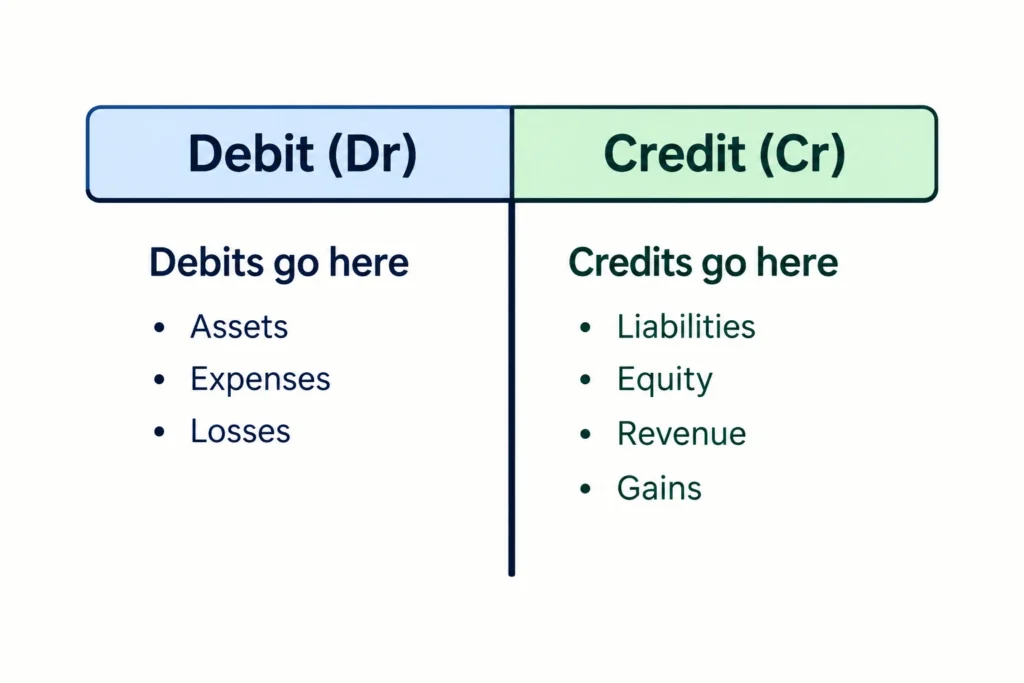
The difference between debits and credits comes down to side, not good or bad. Debits sit on the left side of an account, and credits sit on the right. That one rule drives every ledger, every journal entry, and every financial statement.
This guide explains both terms using plain examples, simple tables, and real numbers. You will learn:
- What debits and credits mean and how they differ
- How each one affects the five account types
- Why total debits must equal total credits
- Three journal entries you can copy
- The mistakes that cause most ledger errors
Key Takeaways
- The difference between debits and credits is the side: a debit is a left-side entry, and a credit is a right-side entry.
- Debits increase assets and expenses. Credits increase liabilities, equity, and revenue.
- Total debits must equal total credits in every transaction.
- The biggest risk is a reversed or wrong-account entry, because the trial balance still balances.
- Start with the DEALER rule, practice three entries, and reconcile your accounts monthly.
What Is the Difference Between Debits and Credits?
A debit is a left-side entry, and a credit is a right-side entry in a ledger account. Neither word means good or bad, gain or loss, on its own. The effect on the balance depends entirely on the type of account.
Rice University’s OpenStax textbook says double-entry accounting requires equal debits and credits for every transaction.
Debit vs Credit at a Glance
| Feature | Debit (Dr) | Credit (Cr) |
|---|---|---|
| Ledger side | Left | Right |
| Increases | Assets, expenses, owner drawings | Liabilities, equity, revenue |
| Decreases | Liabilities, equity, revenue | Assets, expenses, owner drawings |
| Normal balance | Assets, expenses, drawings | Liabilities, equity, revenue |
| Sample entry | Debit Equipment when you buy equipment | Credit Service Revenue when you earn fees |
What Is a Debit?
A debit in accounting increases asset and expense accounts and decreases liability, equity, and revenue accounts. Suppose your business buys a $5,000 printer with cash. You debit Equipment. You also credit Cash for the same $5,000, which keeps the entry balanced. Keep in mind that the difference between debits and credits is never about good or bad, only about which side of the ledger the amount sits on.
What Is a Credit?
A credit in accounting increases liability, equity, and revenue accounts and decreases asset and expense accounts. Suppose you sell services for $1,200 in cash. You credit Service Revenue. You then debit Cash for the same $1,200, so both sides match.
How Do Debits and Credits Affect the Five Account Types?
Debits increase assets and expenses, while credits increase liabilities, equity, and revenue. Accountants call the increasing side the normal balance of that account type. A healthy Cash account, for example, carries a debit balance. This is where the difference between debits and credits becomes practical: the account type decides what each side does.
Account Types and Their Normal Balances
| Account type | Examples | Increases with | Decreases with | Normal balance |
|---|---|---|---|---|
| Asset | Cash, Equipment, Inventory | Debit | Credit | Debit |
| Expense | Rent, Wages, Utilities | Debit | Credit | Debit |
| Liability | Loans, Accounts Payable | Credit | Debit | Credit |
| Equity | Owner’s Capital | Credit | Debit | Credit |
| Revenue | Sales, Service Fees | Credit | Debit | Credit |

Memorize the DEALER rule to speed this up. Dividends (or drawings), Expenses, and Assets increase with debits. Liabilities, Equity, and Revenue increase with credits. In short: D-E-A go up with a debit, L-E-R go up with a credit.
How Does the Accounting Equation Explain This?
The accounting equation states that assets always equal liabilities plus owner’s equity. Assets sit on the left of the equation, so debits increase them. Liabilities and equity sit on the right side, so credits increase them.
Why Must Debits Equal Credits in Every Transaction?
Every transaction touches at least two accounts, and total debits must equal total credits. This rule forms the core of double-entry bookkeeping, the system accountants still use today.
Luca Pacioli published the first printed explanation of double-entry bookkeeping in Venice in 1494, according to the National Library of Scotland. He did not invent the method. He recorded how Venetian merchants already worked.
Historians trace full double-entry records back further, to the Farolfi ledger of 1299-1300. The essentials of the method have stayed the same for more than 500 years.
How Do You Record Debits and Credits in a Journal Entry?
You record each transaction in a journal by listing the debited account first, then the credited account. In a formal journal, the credit line is indented under the debit line. Each journal entry needs a date, account names, amounts, and a short description. The examples below use sample figures.
Three Sample Journal Entries
| Transaction | Debit | Credit | What happens |
|---|---|---|---|
| Customer pays $1,200 cash for services | Cash $1,200 | Service Revenue $1,200 | Asset up, revenue up |
| Business buys $5,000 equipment with a bank loan | Equipment $5,000 | Loan Payable $5,000 | Asset up, liability up |
| Business pays $2,000 office rent | Rent Expense $2,000 | Cash $2,000 | Expense up, asset down |
These entries work the same in any industry. For example, a packaging business that buys a $5,000 machine on a bank loan would post entry 2 exactly as shown. This is where the difference between debits and credits becomes practical: the account type decides what each side does.
What Is a T-Account?
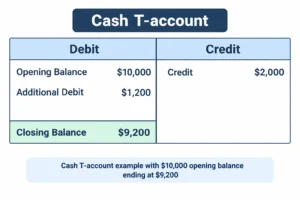
A T-account is a simple ledger drawing with debits on the left and credits on the right. Suppose your Cash account starts with a $10,000 debit balance before these entries. Add the $1,200 debit, subtract the $2,000 credit, and you reach a $9,200 debit balance.
What Is a Trial Balance?
A trial balance lists every ledger account balance and proves total debits equal total credits. If totals differ, you know an error exists somewhere in the entries. Equal totals do not guarantee accuracy. A wrong account with equal amounts still balances.
Why Do Banks Call Your Deposit a Credit?
Banks record your deposit as a credit because the money is a liability to the bank. Your account balance shows what the bank owes you, so deposits raise it with credits. On your own books, the same deposit increases Cash, so you debit Cash. Card names do not follow these rules, so ignore them when you post entries.
What Are the Most Common Debit and Credit Mistakes?
The most common debit and credit mistakes are reversed entries, one-sided entries, and wrong accounts. Nearly all of them start with confusion about the difference between debits and credits.
- Fully reversed entry: You debit Revenue and credit Cash for a sale. Totals match, yet revenue falls instead of rising.
- One-sided entry: You post the debit but forget the credit, so the trial balance fails.
- Wrong account: Amounts balance, but your reports show the cost in the wrong category.
- Swapped digits: You type $1,520 instead of $1,250, a $270 gap.
Use the size of the trial balance gap as a clue:
- Difference divisible by 9: Look for swapped adjacent digits. The $270 gap above equals 9 × 30.
- Difference equals one amount: Look for a missing debit or credit.
- Difference equals double one amount: Look for a line posted to the wrong side.
How Can Small Businesses Keep Debits and Credits Accurate?
Small businesses keep debits and credits accurate by recording entries daily, reconciling monthly, and using accounting software. A 2018 Clutch survey found that 25% of small businesses still record finances on paper. The same survey found 45% employ neither an accountant nor a bookkeeper. Only 53% used accounting software to manage their finances at that time.
Modern accounting software and AI tools have made daily recording much easier since then. Many of them can automate routine bookkeeping tasks such as bank feed matching and recurring entries, though you should still review what gets posted.
Follow these five habits:
- Record every transaction within 24 hours.
- Complete a monthly bank reconciliation against bank and card statements.
- Use a chart of accounts with clear, consistent names.
- Review the trial balance before you close each month.
- Keep personal and business accounts separate.
These habits matter just as much for clinics and care providers as they do for shops and agencies, because every business with revenue and expenses needs clean books.
When transaction volume grows, some owners hand routine entries to outsourced accounting services or invest in better business systems and tools. Whoever handles your books should still check each entry against source documents.
FAQs
What is the main difference between debits and credits?
A debit goes on the left side of an account, while a credit goes on the right. Each one increases or decreases the balance depending on the account type.
Is a debit always an increase?
No. A debit increases asset and expense accounts but decreases liability, equity, and revenue accounts.
Why do debits and credits have to be equal?
Every transaction affects two or more accounts, so the total debits must equal the total credits. This equality keeps the accounting equation in balance after every single entry you post.
Which accounts normally have debit balances?
Asset, expense, and owner drawing accounts normally carry debit balances, while the rest carry credit balances.
What happens if debits and credits do not match?
Your trial balance fails, and you must find the error before you close the period. Check for swapped digits, missing entries, and reversed postings before anything else.
Debits and Credits: What to Remember
Debits sit on the left, credits sit on the right, and every transaction must balance. That simple rule explains the difference between debits and credits in every ledger. Learn the DEALER rule, practice with three entries, and check your trial balance monthly.
Outsourced Accountants publishes guides like this to explain core accounting concepts in plain English.