Software-defined vehicle technology is the greatest transformation in automotive engineering since combustion engine technology. A commercial aircraft is already run by more code than a car and that’s increasing annually.
According to McKinsey, software will make up as much as 30% of the total vehicle value by 2030, from 10% in 2010. That car you’re driving around in your driveway is not a mechanical machine; it’s a computer, for starters.
Daily Techify created this guide using the most current research from IBM, Bosch and the automotive engineering industry worldwide to provide the most transparent explanation of SDV anywhere on the web.
What Is a Software-Defined Vehicle and Why Does It Matter?
The car’s functionality has been dictated by its hardware for 100 years. Add faster brakes? Install new hardware. Improve cruise control? Replace the module. But a software defined vehicle turns that concept on its head: Software determines what the vehicle can do and hardware carries out instructions.
Features are added, enhanced or deleted by changing the code. Automakers can engineer a security flaw in millions of cars and issue a recall, all in one night. Drivers obtain automobiles that really enhance gradually and do not lose value each month.
In the old days of auto development, 3 to 5 years was the timeframe for each year of model change. The software industry enjoys the same speed advantage over hardware manufacturers in all other industries as SDV companies do over it.
What Are the Core Characteristics of an SDV Vehicle?
Not all connected cars are automatically SDV vehicles. SDVs have three distinguishing architectural characteristics that set them apart from vehicles equipped with just a touchscreen and an Internet connection atop a traditional hardware architecture.
Centralized Computing Architecture
More than 100 separate Electronic Control Units are used to disperse intelligence in traditional vehicles. Instead of that disjointed system of computing, SDV vehicle architecture has a lower number of central computers but much more powerful ones, which are able to control all operations from one point.
This consolidation reduces the wiring harness weight of up to 50kg per vehicle and makes manufacturing easier. It also provides a single data environment that meets the real-time software control for all vehicle systems demands.
Over-the-Air (OTA) Updates
The ability for a software-defined vehicle to be updated through OTA for the vehicle is a revolutionary concept that puts the vehicle way out of this world from a product that gets better with each software update. In 2020, Tesla took a single overnight software update and improved regenerative braking and other Autopilot capabilities to millions of existing cars.
In 2024, the worldwide OTA automotive update market was valued at USD 3.2 billion. Its growth is expected to reach $9 billion by 2030, as OTA delivery increasingly plays a key role in the SDV business model with each major automaker.
Decoupled Hardware and Software
The software for a traditional vehicle is tightly bound to its hardware components and such software updates are often tied to the replacement of physical components. With SDV architecture, the two layers are deliberately separated.
Vehicle Software engineers write, test and implement vehicle features without depending on mechanical components. This separation helps to prolong vehicle lifecycles as the manufacturers update their intelligence through code well after the vehicle’s hardware has been taken off the road.
SDV vs. Connected Car vs. Autonomous Car: What Is the Difference?
There are three types of vehicle software, each addressing a different problem and underpinned by a different architecture. The following comparison helps to clarify in what way each concept starts and stops.
| Feature | Connected Car | Software-Defined Vehicle | Autonomous Vehicle |
|---|---|---|---|
| Core Focus | External communication | Internal software control | Self-driving AI |
| OTA Updates | Infotainment only | Entire vehicle system | Safety systems |
| Architecture | Many ECUs + connectivity | Centralized/zonal computing | AI-heavy compute |
| Hardware Dependency | High | Low (decoupled) | Moderate to high |
| Revenue Model | App subscriptions | Feature-on-demand | Mobility services |
| Real Example | Early BMW ConnectedDrive | Tesla Model 3, VW ID.7 | Waymo One robotaxi |
SDV architecture is the base of all autonomous vehicles, not all SDV drives vehicles. Software-defined architecture is the platform for autonomy and it is a prerequisite for self-driving technology.
How Does Automotive Architecture Shift from Hardware to Code?
The Hardware Evolution: From ECUs to Centralized Computing
In a typical 2010 premium car, there were 70 to 100 individual ECUs hard-wired into the vehicle’s frame and wired together into a 3 to 4 km long cable web. The software-defined vehicle architecture unifies those ECUs into three to five zonal computers which all control functions via software routing.
This was achieved by an over 80% reduction in ECUs for BMW. The outcome: reduced manufacturing expenses, weight reduction and a common computing environment in which SDV software must communicate with all vehicle systems at the same time.
The Software Stack Layer
Modern vehicle software is based on layers. Embedded operating systems, such as Linux or QNX, are used as the foundation. Communication between components is mediated by a middle level. At the top, the infotainment, navigation and driver assistance are handled by customer-facing frameworks.
The ability to isolate these layers allows engineers to change customer-facing features without disturbing safety-critical embedded systems. The layered stack is designed to require a more rigorous process for safety software to be validated before it can be installed on the vehicle as opposed to an infotainment update.
What Are the Key Benefits of Software-Defined Vehicles?
As SDV continues to be implemented, the evidence of its impact continues to grow, proving the business and consumer benefits each year on a range of safety, revenue and customer satisfaction measures.
Post-Purchase Feature Monetization
With the post-purchase feature monetization, revenue streams that the traditional model did not capture are achieved. BMW has made more than $100 million in annual recurring revenue from its software feature subscriptions as it sells performance modes and driver assistance software after the initial purchase.
AI-Powered Predictive Maintenance
AI for Predictive Maintenance detects potential component failure before it happens. In its first year of deployment, Volvo’s system reduced the number of unplanned fleet breakdowns by 30%, which directly cut operating costs and improved the customer satisfaction score.
Accelerated Innovation Timelines
Accelerated innovation timelines impact an automaker’s reaction time to competitors. By contrast, cloud-based vehicle simulation enables a much faster code validation process, reducing the time to validate code by up to 50% compared to hardware-first development approaches.
Environmental Sustainability Through Software
The benefits of optimizing software for environmental sustainability are seen after the sale. In 2023, Volkswagen announced a 5 to 8% range boost for existing ID.4 models, achieved via an over-the-air (OTA) update and no need for any new parts.
What Is the Technical Architecture Behind a Software-Defined Vehicle?
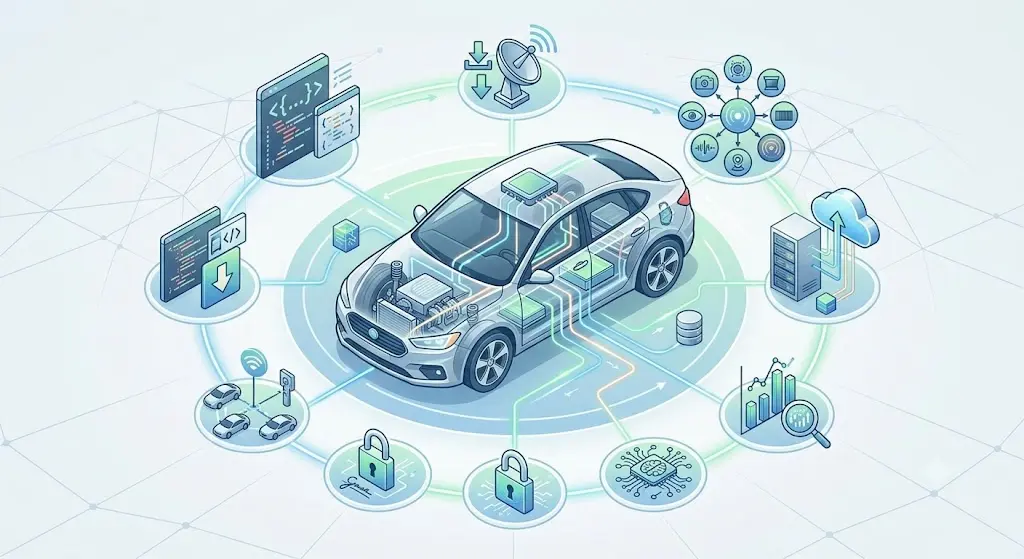
What is a software-defined vehicle? From an engineering perspective, a software-defined vehicle is defined by three connected elements: the SDV foundation components, SDV Features, SDV Operating System and SDV Suite that are described by Bosch.
SDV Features are those characteristics of the car that are visible to the driver and that evolve over the lifespan of the vehicle, ranging from driving assistance modes to energy optimization to customer-specific driver profiles that evolve.
The SDV Operating system coordinates the resources of all the hardware, real-time processing and communication protocols that enable all the vehicle systems to work together rather than in isolation as individual hardware modules.
The SDV Suite includes cloud-based development and deployment infrastructure. It turns vehicle development into an engineering process of constant improvement after the vehicles are in customer hands.
What Engineering Challenges and Security Risks Do SDVs Face?
Cyber security Vulnerabilities
The Software-defined vehicle that helps vehicle connectivity introduces fresh attack vectors to traditional isolated vehicles. There’s no way a software bug in a laptop can have the same safety implications as one in a central vehicle computer but a successful hack of a central computer could allow an attacker to take control of the vehicle’s steering or braking.
Ford and others are responding to this threat by implementing secure boot mechanisms, hardware security modules and real-time network intrusion detection systems. These protections are now required by UN R155 cybersecurity regulation for all new vehicles sold in the EU, China, Japan and South Korea.
Safety-Critical Software Isolation
Vehicle software needs to be completely separated between the functions that control a vehicle’s safety and infotainment. The brake control system and engine management software need to be protected from navigation software or third-party applications accessing or interrupting them.
Hypervisor technology divides the main computing platform into its own different virtual machines, which have their own security barriers. Most of the automakers use the standardized framework of AUTOSAR Adaptive Platform to implement this isolation in production vehicles.
Integration Complexity
SDV vehicle development gets components from hundreds of suppliers which each deliver software based on different architectures and standards. These all need standards that the industry is actively developing, but that have yet to be fully realized, to bring them into a single platform. These standards are being actively developed by COVESA, SOAFEE and AUTOSAR but have not yet been completed.
Which Automakers Lead Software-Defined Vehicle Development in 2026?
The software-defined vehicle leadership is a clear distinction within the automotive sector, based on software capability. Tesla set the benchmark for all other car manufacturers, releasing more than 50 OTA updates for all its vehicles in 2024 alone.
Volkswagen Group plc has poured more than USD 2,400 million into its automotive software firm, CARIAD, in order to develop the shared platform that will be used by all the VW, Audi, Porsche and Skoda car brands by 2028. Initial problems exposed the hardships of transitioning from hardware to software engineering culture.
BMW’s E3 2.0 vehicle operating system is used on the latest generation and allows for complete over-the-air updates to the powertrain, chassis and driver assistance systems. The feature-on-demand subscription model proved the possibility of commercially viable monetization of the post-purchase model made possible by SDV architecture.
What Does the Future of Software-Defined Vehicle Technology Look Like?
According to Daily Techify, whose main focus lies on one significant point of all three SDV predictions by McKinsey, Gartner and IBM, the move from hardware-defined to software-defined cars will be an irreversible tipping point that is going to happen prior to 2030. The SDV market is predicted to expand by 5.5% CAGR up to $462 billion by 2030.
These AI entities incorporated into cars are capable of dealing with all aspects of driving on their own, including learning preferences and predicting maintenance, managing energy consumption in real time and negotiating with intelligent systems of the smart cities.
Vehicles will be able to change all aspects of the driving environment with software, thanks to Hyper-personalization. The system will automatically adjust suspension tuning, display configurations, audio profiles and energy management based on the driver’s seat occupants.
As sensor technology and traffic regulations become more advanced, the autonomous workflow capabilities will extend from highway assistance to more complex urban navigation. For the level 4 and 5 autonomy, the software foundation is provided by SDV architecture and continued SDV investment is a direct prerequisite for every automaker with autonomous ambitions.
Conclusion
The era of software-defined vehicles is not something to be achieved in the distant future because such vehicles are already being produced. All OTA updates, predictions of possible malfunctions and unlocking features after purchase prove that the software defines the evolution of the automotive industry much more efficiently than any hardware. At Daily Techify, we believe understanding this shift puts drivers, engineers, and businesses miles ahead of those still waiting to pay attention. The brands that invest in SDV vehicle platforms today will define the roads, the revenue, and the driving experience of the next decade.
FAQs
What is the difference between vehicle software and a software-defined vehicle?
Traditional vehicle software is based on individual packages, tasks and ECUs. An SDV has the ability to run a single platform to manage all of its vehicle functions; it gets OTA updates for all of its systems, and grows without reliance on hardware throughout its life.
Is it possible to make an old car a software-defined car?
No. The software-defined vehicle demands a centralized computing architecture that is basic to non-SDVs. It’s not just that there are new attack surfaces with SDV capability, there are security solutions that can only be enabled by changing the underlying hardware.
What is the process for an SDV vehicle to receive OTA updates?
The SDV vehicle interfaces with the cloud-based software platform of the automaker which pulls encrypted software packages when the car isn’t being driven verifies them using cryptographic checksums and installs software updates without losing rollback capabilities if any component fails the validation on installation.
Are software-defined vehicles a more attractive target for hacking?
The software defined vehicle platform creates new attack surfaces as well as new security countermeasures that weren’t present in traditional vehicles. Solutions like secure boot, hardware security modules, encrypted communications and real-time intrusion detection actively watch for and combat threats that are ignored by traditional cars.
What are some of the automakers that currently offer a true software-defined vehicle?
At present, only Tesla, BMW, Mercedes-Benz and Volkswagen Group are using SDV vehicles. BYD, NIO and Li Auto are also Chinese brands that use SDV platforms but deliver an even more intensive OTA service compared to their western counterparts.