Introduction
AI models are as intelligent as the data they can access. And that is what agentic RAG will solve. Rather than dragging responses out of a single predetermined array of knowledge, it allows AI actors to plan, search and verify their own work and then respond. Here is a basic explanation of the mechanics of it.
What Is Agentic RAG?
It is an AI agent-enhanced retrieval augmented generation (RAG) system. An ordinary RAG system links a language model to a single knowledge base and retrieves information to respond to a query. Going even further, agentic RAG provides the model with the capability to think, select tools, extract data in multiple sources and correct its own errors.
This is important since real questions are not usually easy. A support request may require information in a manual, a price sheet and a historical ticket simultaneously. That type of multi-source work is done by agentic RAG and is not directed to the correct direction every time by a human.
How Does Agentic RAG Work?
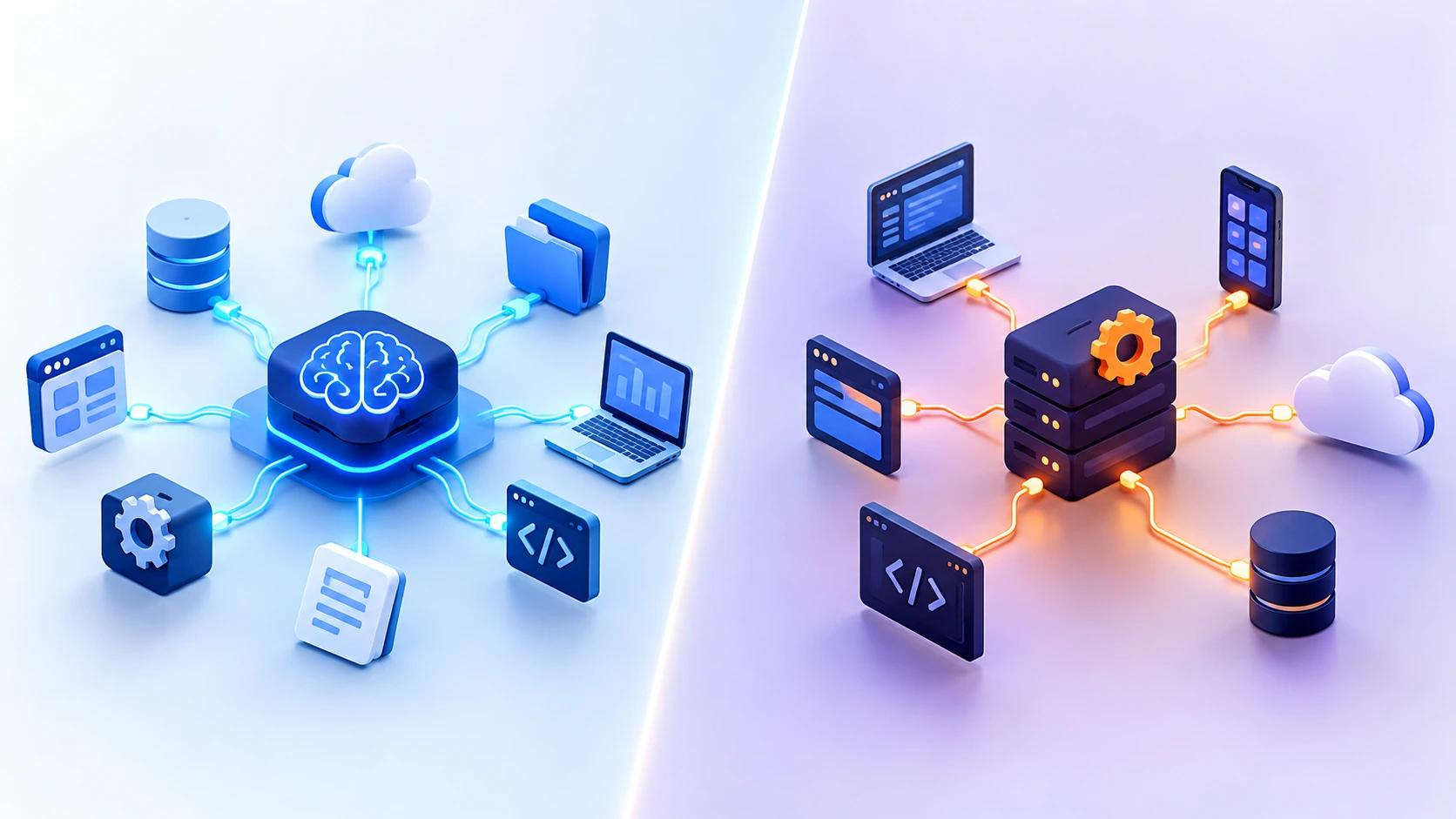
The core idea is to place one or more AI agents inside the retrieval pipeline — a setup closely related to broader AI agent orchestration, which we’ve broken down in detail separately. Each agent has a job: one might search internal documents, another might scan emails, and a third might query a live database.
Upon receiving a question, an agent divides it into smaller bits when necessary, chooses which source is suitable to each part and retrieves the data. The system then verifies the answer whether it fits the question or not. In case of missing something, it can do a new search rather than provide a weak response.
Agentic RAG Architecture
Knowledge of agentic RAG architecture can be used to understand why this approach is more adaptable than the older ones.
Key Components
The common configuration is an embedding model, a vector database, one or more retrieval agents, a planning agent and the generative model which writes the final answer. The issue of memory is also crucial, as agents save previous queries and answers to be able to use the useful context in the future.
Agentic RAG Architecture Workflow
Typically, the workflow follows the following order: a query is received, a planning agent draws a graph of the steps, retrieval agents retrieve information in various locations and the response is assembled and the model writes its answer. The system will be able to recycle in case the quality of answers is weak.
Agentic RAG vs. Traditional RAG
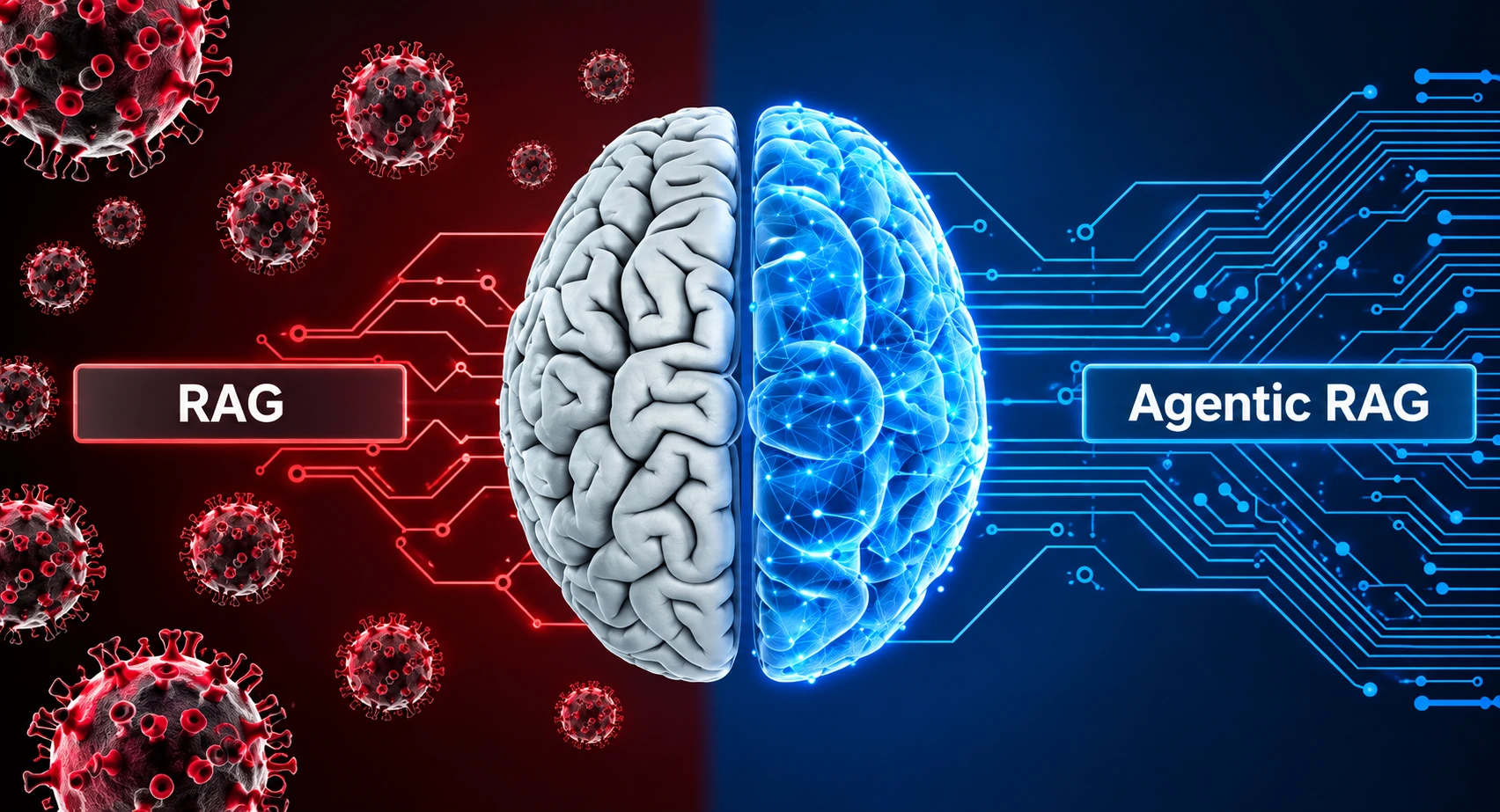
The distinction between both of them lies in the aspect of control and flexibility. Traditional RAG is deterministic, where search in a single dataset is performed and the closest result is returned but there is no measure of whether the result is good or not.
The agentic RAG is more of an assistant than a program. It draws on various databases, selects tools based on the task and scans its output. Consider traditional RAG a checklist-following employee whereas agentic RAG is a proactive employee. This increases its accuracy and flexibility, but requires a higher cost to operate, as it consumes more compute and tokens.
Agentic RAG Systems
It has a few standard methods of constructing Agentic RAG systems, depending on the complexity required by a task.
Single-Agent RAG
The simplest form. Routing, retrieving and quality checking are carried out by one agent. It fits small projects that do not require the use of several data sources.
Multi-Agent RAG
Several specialized agents work together — one handles documents, another handles structured data, and a coordinator merges their results into one answer. This mirrors ideas from distributed computing, where independent nodes each handle part of a task and combine results.
Router-Based Agentic RAG
A routing agent will automatically send the query to the appropriate location; it is determined by a routing agent which source of knowledge or tool can best answer the question asked.
Agentic RAG Workflow
An exemplary agentic RAG workflow begins with interpreting user intent, planning, selecting the source, retrieving it and generating a response. A large number of systems involve a self-checking step in which the agent examines its answer and then transmits it out, which is a significant factor why results are generally more accurate than older techniques.
Agentic RAG Frameworks
These systems can be built easier with several open-source agentic RAG frameworks. Commonly used agents to connect with data sources are LangChain and LlamaIndex, whereas LangGraph is useful to handle workflows that require many steps. The open model of teams such as Granite, Llama and so on enables agentic RAG pipelines to be constructed at a lower cost with a greater understanding of agent decision-making.
Agentic RAG Use Cases
Practical use cases span several industries. Support teams use it to answer complex questions by pulling from manuals, tickets, and FAQs at the same time. Companies use it to search internal knowledge so employees don’t have to dig through shared drives. If you’re comparing tools before building your own pipeline, AI Dukes’ breakdown of AI SEO content optimization tools is a useful reference point for how AI tools get evaluated in practice.
Benefits and Challenges of Agentic RAG
The advantages are evident: enhanced accuracy, increased versatility and the capability to deal with more difficult questions without the need to have a human operator nearby. However there are trade-offs as well. The more agents there are, the more it costs and the slower it may react and agents may conflict or resource contend. No system can eradicate the risk of wrong answers.
When Should You Use Agentic RAG?
When you only require a single source and straightforward lookups, then traditional RAG may suffice. However, in the case of a task with multiple sources, context change or greater accuracy requirements, agentic RAG justifies the additional cost. It is suited in customer service, research tools and workflows where a false answer is costly.
More organizations are adopting agentic RAG as they look for smarter, more reliable systems. It will probably be used to replace traditional RAG in most serious enterprise applications as the tools and framework continue to improve.
FAQs
1. How Does It Work?
It employs specialized agents to deconstruct questions, get data through various sources and confirm the final answer and then respond.
2. What can I do to implement an agentic RAG customer service automation system?
Assign your support documents and ticket history to a retrieval agent, add a routing agent to other types of query and configure a check step to escalate complicated issues to a human.
3. What is the difference between Agentic RAG and traditional RAG?
Classical RAG queries a single fixed source and doesn’t self-check. It also uses multiple sources, makes its own routing decisions, and evaluates its own performance.
4. So what is Agentic RAG?
It is a system that integrates AI agents with retrieval augmented generation, where the AI can search through multiple sources and plan steps and refine its own responses.
5. What are the best Agentic RAG frameworks?
Popular starting points of building agentic RAG systems are LangChain, LlamaIndex and LangGraph.
6. Which are the best platforms of Architecture Behind the System?
The most popular platforms include LangChain, LlamaIndex, LangGraph and enterprise versions such as IBM Watson.