Intro
Take a glance at your Facebook feed and you’ll likely find a face smiling back at you that wasn’t meant to be human. Entertainers, pop stars and brand ambassadors are no longer being cast from reality they are now being built from code in the world of AI in entertainment. We monitor this change here at Daily Techify every single day because it is changing faster than any other corner of tech and culture, put together.
What Is AI in Entertainment?
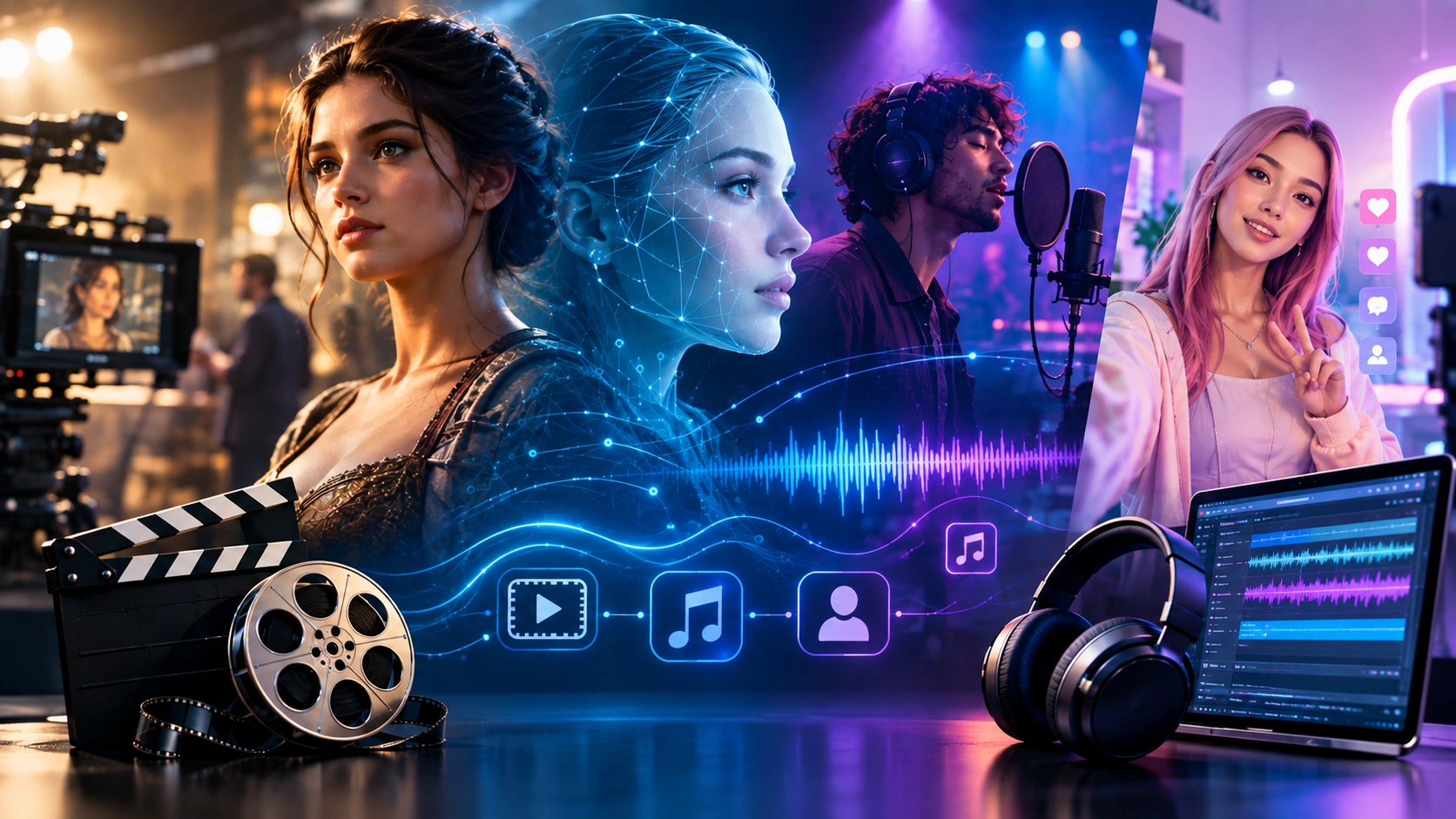
Now, what does the phrase really mean? AI in Entertainment is the increasing application of AI-based tools and technologies for generating, casting or assisting with the production of movies, music, games and marketing materials. From a full-synthetic character playing out on screen to an algorithm learning a pop song in less than a minute. The world of entertainment has passed the experimental demo phase of AI and is now affecting real production, real ad campaigns and real revenue streams.
The Rise of AI Actors
What is an AI actor? (Tilly Norwood case)
Meet the actress who never walked a red carpet, didn’t take acting classes and by all intents and purposes never actually existed at all: Tilly Norwood. Norwood is an AI actors created by the studio Xicoia which was established by Dutch comedian and producer Eline Van der Velden, who is also the co-founder of the Dutch studio Particle6 Productions. She made her debut online back in 2025 and by the end of September, her creators shared that talent agents were interested in her; the result was a Hollywood controversy that had spread across the nation in virtually an instant.
Industry reaction — SAG-AFTRA, copyright and creative-rights debate
Hollywood wasn’t silent for long. Thousands of performers are represented by the union, SAG-AFTRA which claims that Norwood is not an actor but a character “routed” by the work of numerous “professional performers” who didn’t give him their approval or pay. The project was publicly denounced by stars such as Emily Blunt, Melissa Barrera and Mara Wilson shortly after. The backlash comes from the 118-day SAG-AFTRA strike of 2023, which helped win the industry its first contractual protections against unauthorized use of AI likenesses, protections that SAG-AFTRA believes are still lacking today.
Where AI actors are being used today (ads, virtual hosts, dubbing)
Facing less attention in the press, AI actors are already doing more mundane, less controversial work. Brands take their low-budgeted variations of their ads and seek to convince audiences of the same message by using synthetic actors rather than humans for each market. AI dubbing capabilities are pivotal for streaming platforms which depend on AI-powered tools that synchronize lip movements between languages, significantly reducing localization time from weeks to days. Product demos and livestreamed shopping events are now available around the clock with the help of virtual hosts. Virtual hosts now present product demos and livestreamed shopping events around the clock, something no human presenter could realistically manage.
Virtual Influencers Taking Over Entertainment Marketing
Synthetic talent has been used for years in marketing teams before Hollywood ever realized. According to various industry data trackers, the virtual influencers market will reach a value of nearly $11.7 billion in 2026, growing at a rate of almost 40 percent on an annual basis. Brands love these digital personalities for some reasons: they will never get old, never make headlines for scandal and never say no to a 3 am shoot.
How brands use 24/7 multilingual AI avatars
One AI avatar can run a live stream in Mandarin then switch to Spanish for the next campaign and finally respond to customers’ questions in English without getting any sleep or having conflicts. This is the most heavily relied upon for fashion and beauty brands who have avatars to greet their shoppers, model outfits and respond to all comments as they happen. When marketing budgets extend across dozens of regions, the efficiency math gets quite hard to deny.
Meta Horizon Worlds and AI-powered virtual concerts
It has been the same story with live entertainment. Artificial agents are now playing musical shows in virtual spaces such as Meta Horizon Worlds, choreographing performances for audiences who remain, to date, at home. The events give artists, real or synthetic, a global audience without the effort of a touring schedule and there have been some live concerts online that have attracted millions of viewers at the same time.
Audience trust and authenticity concerns
Not all of the metrics are in favor of the machines, however. Virtual influencer campaigns record engagement rates of around 5.67% which is almost three times higher than what is normally seen for human creators (1.89%) but trust is a different matter. Audiences have repeatedly said that they want clear labelling when a persona is not real and younger viewers are more accepting of anything but they still want honesty about who or what they are following.
AI in the Music Industry
It’s as easy to synthesize a sound as it is a face. In 2026, the AI in music industry discussion took a significant turn for the worse when streaming service Deezer announced that approximately 44% of all new songs they upload are entirely AI-generated, roughly 75,000 songs every day. It was one figure that changed the course of debate for years on whether machine-made music would be a fad or a fundamental change in the way songs are truly made.
AI-generated tracks and composition tools
Suno and Udio are tools that allow anyone to enter a mood, genre or lyric concept and obtain a completed song within a minute or less. Suno alone claimed to have crossed 100 million users by February 2026, with nearly 2 million paying users contributing nearly $300 million in revenue per annum. The Music Plug-In that used to need a studio, session musicians and a producer is now contained in a little box of text.
How labels and artists are responding
The big labels are split in their responses. Warner Music signed Suno and Udio and Universal only signed Udio, leaving them in a bind and in litigation with Suno. Neither company has been satisfied with the outcome of the settlement and both are suing Sony. But musicians have not gone silent, either: A year after the American Federation of Musicians filed a lawsuit against two large labels, the musicians allege they were not receiving fair compensation from the deals AI companies have made on their behalf.
Real examples of AI-assisted music production in 2026
Many working artists are using these tools as a foundation, creating rough demos, backing tracks, instrumental beds and then adding to the mix with human voices. For independent podcasters and game developers, platforms such as Stable Audio offer a good option to get royalty-free background music without all the hassle of licensing. There is an increasing blurring of the line between AI music and AI-assisted music and that’s where most working musicians now live.
Why AI in Entertainment Is Accelerating in 2026
Three forces are driving the adoption agenda forward more quickly than most anticipated. As the models improve, so do the production costs, meaning that smaller studios can take on projects that were only previously the domain of big budgets. Consumers also continue to accept synthetic materials, even if they don’t know they are synthetic. The rest is taken care of by competition: as soon as one brand or studio uses an AI shortcut and makes a fortune off of it, others will not be long in coming. All these factors account for the swift transition of AI in entertainment from the realm of novelty to the norm in merely a few years.
Risks and Open Questions
Deepfakes and authenticity
It is the same technology that enables a helpful virtual host that can also create a celebrity endorsement that didn’t actually occur. While the quality of detection continues to improve, a good fake continues to improve as well and the difference between the two is becoming smaller with each passing month.
Performer rights and labor concerns
Performers say the industry advanced too quickly for protections. While SAG-AFTRA’s 2023 contract explicitly referenced background actor scans, many working actors disagree that there are clear guidelines governing background actors’ use of synthetic likeness in advertising and marketing that they are earning real income.
Copyright and ownership gaps
The courts have yet to decide if training AI models on copyrighted performances and recordings is considered fair use or not. Everybody’s deal is currently on hold and a highly anticipated Sony v. Suno trial in mid-2026 may help to tip the scales in licensing economics for the entire industry.
What’s Next for AI Actors, Virtual Influencers and AI Music
Be prepared for some uneven enforcement of regulation. Clear AI in entertainment industry labelling will be required in some areas ahead of others, resulting in a patchwork that will require brands to tread carefully when it comes to global branding. It’s time to expect licensing not litigation between AI companies and rights holders just as Warner and Udio have done. But don’t look for the legislation to ultimately determine how much synthetic talent they’ll accept and that’s happening one click, one stream and one purchase at a time.
Conclusion
The era of entertainment castings, marketing budgets and recording studios being forever transformed by AI in entertainment is here and the brands that are already paying attention will be the ones that are followed years from now. Join us at Daily Techify as we continue to follow this tale, covering court decisions and the next viral AI star.
FAQs
What does the term “AI” mean in the entertainment industry?
Today, AI is applied in entertainment through machine-generated movies, games, music and marketing materials, such as social media posts, YouTube videos and videos.
What is an AI actor?
An AI actor is a synthetic human actor such as Tilly Norwood and is constructed from code not from a real person’s appearance.
Are virtual influencers taking the place of real influencers?
Not entirely. The average engagement rate of virtual influencers is greater than that of human creators and audiences remain responsive to creators who are real, relatable and human.
What are the applications and use of AI in the music industry?
Now, the music industry uses AI tools to create entire songs from text prompts in just a few seconds, such as Suno and Udio.
Does AI made music count as copyright?
The U.S. Copyright Office at the time of this writing will not register AI-generated works in their entirety and this issue remains unresolved as litigation plays out through 2026.