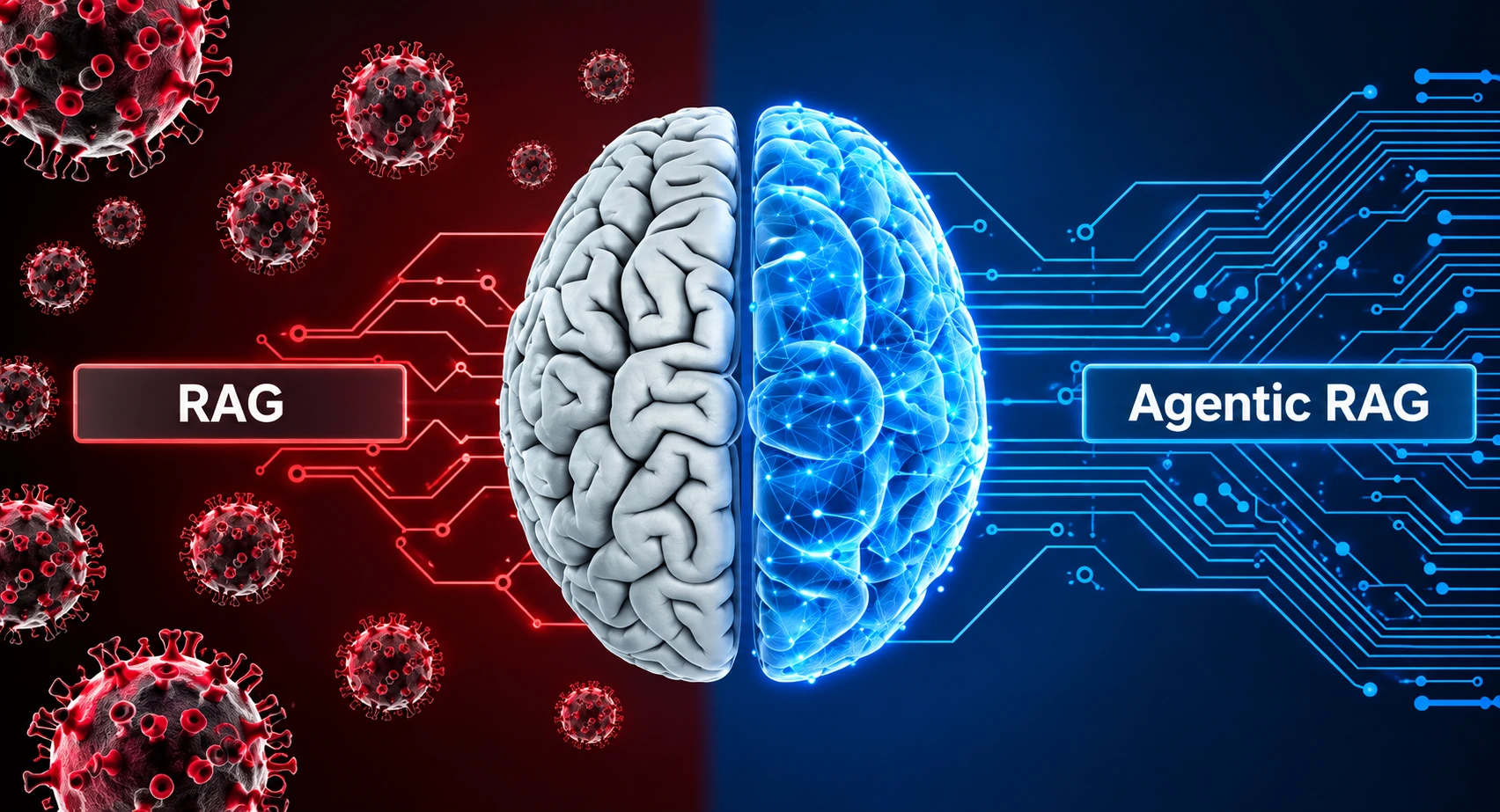
When you have been creating AI apps recently, you have likely encountered two terms that are close to each other in sound, but entirely different in their behavior; namely, RAG and Agentic RAG. The concept of RAG vs Agentic RAG is rapidly gaining importance among anyone creating AI systems that require access to and reasoning upon real-world data, as choosing the wrong one can be the difference between a system that simply answers questions and one that actually does work. At Daily Techify, we break down concepts like this regularly to help builders make faster, better-informed architecture decisions.
This guide disaggregates what each approach is, how they are different under the hood and which one makes sense to your use case.
What Is RAG?
RAG stands for Retrieval Augmented Generation which is a technique used to enable a language model to use information from outside sources before coming up with a response. In RAG, the relevant document or data from the knowledge base (which is a vector database) is retrieved and is inputted in the prompt of the language model.
Flow is simplistic:
- A user poses a query.
- The system scans a body of knowledge to find the pertinent text chunks.
- Those pieces are added to the prompt.
- The model provides that context added with an answer.
It is a quick and predictable process of single-pass retrieval that is effective in question-answering over static documents such as manuals, policies or internal wikis.
What Is Agentic RAG?
The Agentic RAG is based on the same principle, only it includes an element of autonomous decision-making. An AI agent will not make one fixed step of retrieval but will determine when to retrieve, what to retrieve and how many times to repeat the retrieval before responding.
Practically a system of agency may:
- Divide the complicated question into smaller sub-questions.
- Ask questions to more than one data source or tool.
- Assess the sufficiency of information retrieved.
- Re-retrieve, narrow the search or submit a subsequent query when the initial search is unsuccessful.
- A combination of reasoning steps and retrieval steps takes place in a loop until a confident answer is obtained.
This is the fundamental difference between the RAG vs Agentic RAG argument: RAG uses a predetermined retrieve-then-generate pipeline, and Agentic RAG uses retrieval as one of the tools which an agent can invoke, reason about, and repeat as necessary.
RAG vs Agentic RAG: Key Differences
| Aspect | RAG | Agentic RAG |
|---|---|---|
| Retrieval flow | Single-pass, fixed | Multi-step, dynamic, looped |
| Decision-making | None – retrieval is scripted. | The choice of when/what to retrieve is at the discretion of agent. |
| Complexity | Less complicated, less complex, more convenient to construct and debug. | Up more moving parts. |
| Tool use | Generally a single knowledge base. | Is able to invoke several tools, APIs, or sources. |
| Best for | Simple question and answer on fixed data. | Multi-step reasoning, tasks The type of research. |
| Latency | One round more, And a quicker round. | Slower, as a result of iterative processes. |
| Failure handling | Limited — no self-correction | Has an opportunity to re-run or improve low scores. |
Agentic Search vs RAG: Where the Line Gets Blurry
It is worth stating that agentic search vs RAG is not always a black and white situation. Other systems overlay some light agentic behavior such as query rewriting or re-ranking on top of a relatively traditional RAG pipeline. That remains RAG in spirit as there is no continuation of independent decision-making. In true agentic RAG, an agent is capable of planning, adapting and acting more than one smarter action, rather than a single action of retrieving.
Agentic Retrieval Techniques Worth Knowing
Several agentic retrieval methods can be found in real-world applications:
- Query decomposition – breaking down a complex query into smaller, specific sub-queries.
- Iterative retrieval – a series of retrieval runs and refinements to the search by using previous results.
- Tool routing – allowing the agent to select a vector database or a web search tool or a structured API based on the question.
- Self-reflection – the agent can access the context of its own retrieval and then produce a final answer.
These are the techniques that provide agentic RAG with its advantage in multi-hop questions that are complex and require more than one retrieval pass to be accurate.
When to Use RAG vs Agentic RAG
The decision between RAG vs Agentic RAG is a matter of complexity of the task and the amount of latency you can afford.
Use RAG when:
- Questions are focused and can be answered in one place.
- You need fast, predictable response times
- Your knowledge base is properly organized and does not need any cross-reference.
Use Agentic RAG when:
- Questions involve several stages of thinking or investigations.
- The system must be able to draw on more than one source or tool.
- Precision is better than speed and a bit of latitude is okay.
- It is not a mere look up but a task that is similar to what a human researcher or analyst would perform.
FAQs
Is Agentic RAG always better than RAG?
No. Agentic RAG introduces latency and complexity which is not needed in simple lookup operations. Simple Q&A Standard RAG is most commonly a more efficient option.
Is there a replacement of traditional RAG with Agentic RAG?
Not quite – Agentic RAG does tend to make use of RAG as one of its building blocks. To what and when the retrieval is invoked is determined by the agent, although the mechanism of retrieval remains comparable to regular RAG.
Does Agentic RAG become more difficult to construct?
Yes. It needs an agent architecture with the ability to plan, use tools, and make decisions iteratively, which brings an engineering burden to a simple retrieve-then-generate pipeline.
Is it possible to have RAG and Agentic RAG in a single system?
Yes. Simple requests are handled by standard RAG and more complex requests are wayed to an agentic pipeline by many production systems, trading off speed and accuracy.
Conclusion
RAG vs Agentic RAG is not about which architecture is objectively better than the other but rather about a fit between the architecture and the task. RAG is the less complex and quicker method of direct question-answering, whereas Agentic RAG is given its complexity when a system must reason, plan and retrieve over more than one step. Since AI applications continue to shift to more autonomous, multi-step workflows, this distinction will only be increasingly significant to anybody who is building with retrieval-based AI. Follow DailyTechify for more breakdowns like this as agentic AI architecture keeps evolving.
To learn more about the way retrieval systems get their information, we have previously broken it down in our RAG Data Sources and to learn more about creating AI-driven products, visit OnesLogic and Aidukes.