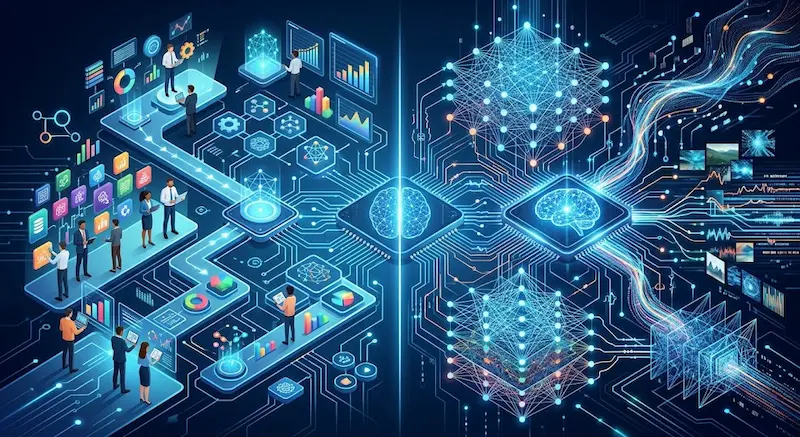
The digital world is changing more rapidly than ever before through Artificial Intelligence and not a single reader can say they have never felt lost with the comparison of ai vs machine learning vs deep learning. The search interest in AI-related terms has increased over 400% since 2019 but the majority of people fail to understand the actual distinction between the three concepts. According to industry reports, the global AI system expenditure is expected to surpass $300 billion by 2027 and a massive portion of the investment goes directly to deep learning and machine learning systems. This guide simplifies the confusing ai vs ml argument in simple language, so at the end, you will understand the specific technology used in your favorite apps and the technology required in your next project.
Consider it this way: AI is the umbrella, machine learning is within that umbrella as one strategy for achieving intelligence and deep learning is even within machine learning as a specialized method. When you understand this nesting construction, all the buzzwords you see on the Internet will begin to make much more sense. We think these basics will guide smarter technology choices at Daily Techify, whether you’re a student, a developer or a business owner making your next product.
What is Machine Learning (ML)?
Modern automation is based on machine learning. It is a subdivision of AI where algorithms acquire knowledge based on data patterns without having to be programmed for each specific case. The developers do not have to write thousands of manual rules to feed the model; instead, they feed the model with examples and the model determines patterns itself.
The general process of work is based on three very simple steps: data input, model training and prediction or output. Engineers take data, train a model with it and subsequently make predictions with the trained model on new, unseen data.
We live in the real world. ML classification models identify unwanted messages almost 99 percent with email spam filters. The recommendation engine that Amazon uses to facilitate an estimated 35% of the total revenue of the business heavily depends on machine learning. The Netflix personalized feed algorithm is a tool that is used to analyze viewing behavior among over 200 million subscribers to recommend your next viewing.
Linear regression, decision trees, random forests and support vector machines are popular algorithms in the machine learning umbrella. All of them have a place in various kinds of problems and the appropriate algorithm can be a far more important consideration than adding additional computing power to the problem. The flexibility enables machine learning to be a feasible, cost-effective entry point in most companies making their initial attempts at automation.
What is Deep Learning (DL)?
Deep learning goes a few steps beyond that. It is a highly developed evolutionary form of machine learning that replicates the human brain with the use of artificial neural networks. Those networks stack dozens or even hundreds of layers and each layer derives more and more sophisticated features out of raw data.
The processing of large volumes of unstructured data, including images, audio and video with these multi-layered networks and allowing the system to learn hierarchical representations itself is the workflow of this method.
Self-driving Tesla vehicles analyse real-time camera images with deep neural networks to identify pedestrians, lanes and obstacles. Deep convolutional networks are used in facial recognition systems, which are currently integrated into over a billion smartphones in the world. The development of deep learning has come a long way, as demonstrated by large language models such as ChatGPT which have hundreds of billions of parameters.
The most common architectures are the Convolutional Neural Network (CNN) directly applied to image tasks, the Recurrent Neural Network (RNN) when working with sequential data such as speech, and the Transformer which is now utilized by nearly all major language models on the market. The Stanford AI Index study reveals that the number of parameters in the most popular models has increased approximately 10fold every two years which is why deep learning continues to achieve new performance benchmarks in industries.
Deep Learning vs Machine Learning: Key Differences
Knowledge of the differences between these two technologies will enable you to select the correct tool to use in your project. These fundamental differences can be summarized as in the table below.
| Feature | Machine Learning | Deep Learning |
|---|---|---|
| Data Needed | Small to medium datasets | Massive datasets (millions of samples) |
| Hardware | Standard CPUs | GPUs / TPUs required |
| Feature Extraction | Manual, done by engineers | Automatic, via neural network layers |
| Training Time | Minutes to hours | Days to weeks |
| Accuracy on Complex Data | Plateaus with large datasets | Improves with more data, often exceeds 95% |
Data and Hardware Dependencies
These two technologies are very different in terms of data requirements. Machine learning can be used on smaller datasets (as few as a few thousand rows) and can be efficiently executed on regular CPUs. Deep learning, in contrast, requires huge amounts of data, commonly millions of labeled examples and expensive hardware support in the form of GPUs or TPUs to learn. The energy that researchers at the University of Massachusetts needed to train one big deep learning model is comparable to that used by several households over a year.
Feature Extraction
One of the most obvious divides is feature extraction. Machine learning involves human engineers classifying and extracting features of interest manually before training. This is all automated by deep learning in its neural network layers, revealing latent patterns that humans might never even consider searching.
Execution Time and Accuracy
The speed of training is vastly different in the two methods. The ML models are very fast to train, taking minutes or hours but the precision levels off after a specific size of the dataset. DL models require days or even weeks to learn a large dataset, but achieve unmatched accuracy; some deep learning image classifiers have now reached over 95% accuracy, which is higher than the average human accuracy of about 94%.
Difference Between Machine Learning and Deep Learning with Examples
These differences are better explained in real-life contexts rather than through definitions. To cement your knowledge, we are going to go through a facial recognition case study.
The ML Approach involves feeding the algorithm with mathematical distances between the ears, nose and eyes manually. It takes weeks of work by engineers to create these features and the model is still incapable of learning.
The DL Approach does not involve such manual work. All you do is feed raw images into the neural network and it determines the identifying facial features all by itself and it is usually much more accurate with a lot less human intervention.
The same trend is carried over to industries. In healthcare, ML models can forecast patient readmission probability by using structured data, such as age, blood pressure and laboratory tests, whereas DL models can scan unstructured MRI images and X-rays to identify tumors that are occasionally missed even by highly trained radiologists. In finance, ML detects fraudulent transactions based on pattern rules, whereas DL detects rings of fraudsters by processing millions of sequences of transactions that change their strategies continuously.
When to Use Machine Learning vs Deep Learning?
The selection of the appropriate technology will solely be based on the size and resources of your project. Select Machine Learning when your data is small, your budget is small and your data is well-organized, such as Excel sheets and database tables. ML models are also more effective in cases where you need to have clear explainability due to regulatory or business considerations.
Use Deep Learning when your data is immense and not structured, like raw audio, continuous video, or millions of images and the task is very complicated. The petabytes of unstructured data that companies such as Google and Meta handle daily render deep learning the sole viable choice for them.
A common pattern in startups and small teams is to begin with machine learning first, as it allows them to launch a working product in a short time and test demand without investing in big GPU clusters. When the product is scaled and the dataset becomes large enough, lots of teams start to add deep learning elements to the pipeline to address the harder, unstructured aspects.
Is Deep Learning Better Than Machine Learning?
The decision will be made based on circumstances and not the hype. Deep learning is not necessarily the best option. It is costly to compute, requires dedicated hardware and tends to be a black box with minimal interpretability. According to a recent survey conducted in the industry, almost 68% of businesses continue to use traditional machine learning models for structured business data since they are less time-consuming to deploy and their decision-making processes are easier to explain to the stakeholders. Deep learning is better when data is plentiful and complexity is great, whereas machine learning frequently prevails in quickness, cost and visibility.
Conclusion
Both deep learning vs machine learning are essential components of contemporary technology and both of them are leading to automation in all industries such as healthcare, finance and entertainment. There is no universal better technology of choice, what is right is always relative to your data, resources and objectives. What technology are you using in your forthcoming development project? Write a comment and tell us!
FAQs
What is the main difference between AI, ML, and deep learning?
AI is the general term for machines imitating human intelligence. Machine learning is a branch of AI that gains knowledge via data and deep learning is another branch of ML that learns through multi-layered neural networks and processes unstructured data.
Is deep learning always better than machine learning?
No, deep learning is not necessarily superior. It requires huge datasets and costly hardware, whereas machine learning is more effective on smaller datasets and remains simpler to interpret.
Does machine learning need deep learning?
Yes, machine learning pre-dates the popularization of deep learning by many decades. Numerous algorithms, such as decision trees and linear regression, do not even need any neural networks.
Which is the easiest to learn, ML or DL at the beginning?
Starting with the basics of machine learning is recommended, as they form the statistical background that is required to comprehend the concepts of a neural network in deep learning in the future.
Do I need a GPU to use machine learning or deep learning?
Collectively, machine learning models are usually runnable on ordinary CPUs. Deep learning models, in turn, generally require GPUs or TPUs to train on large data sets in a sensible time.