A great number of sensors, cameras and smartphones are generating massive amounts of data that centralized clouds cannot analyze on time. The disparity in data creation and data processing is why Edge computing has gone from being a niche IT concept to a real backbone of the industry. Mordor Intelligence projects that the global edge computing market will grow to approximately $257 billion by 2026 and other analysts agree that it’s just getting started. Here at Daily Techify, we’re putting the pieces together to understand the details of edge computing, how it works in practice and how it is quietly transforming everything from your smart thermostat to self-driving cars.
What is Edge Computing?
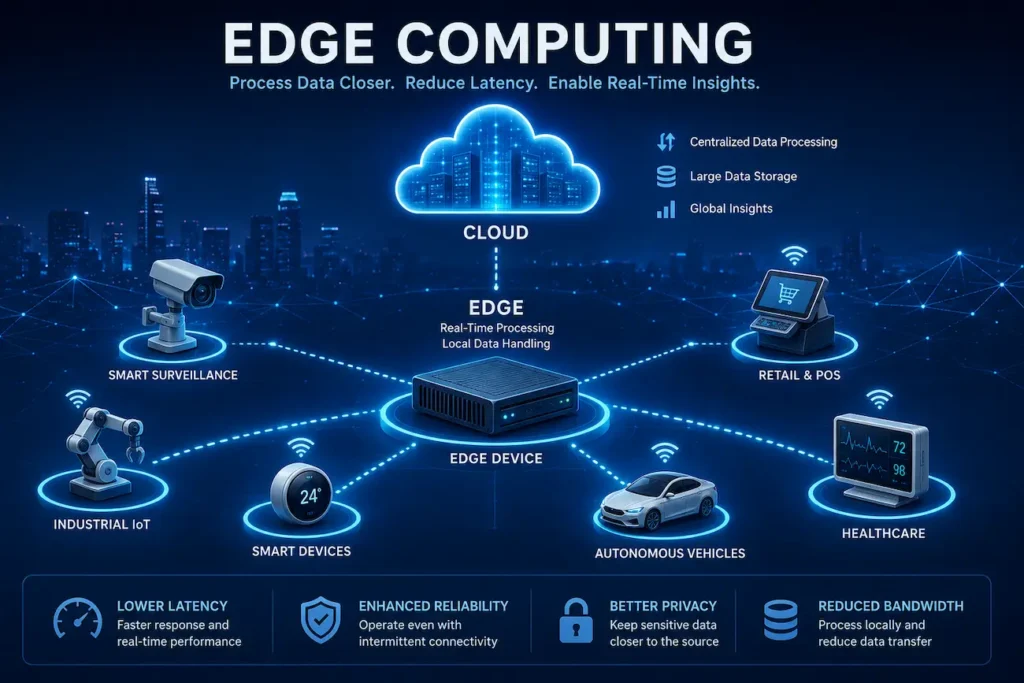
Edge computing is a distributed computing model that processes data physically near to its source, such as a device, sensor, or local server, rather than sending all of this information to a distant central cloud. In contrast to a journey to a far-off data center, computation takes place right at the “edge” of the network, reducing latency and alleviating bandwidth strain.
How Does Edge Computing Work?
The structure of edge computing is easy to understand, consisting of three stages: first, the edge devices gather raw data; second, the data is processed at the edge; third, the cloud acts as a backup when it is necessary to do more in-depth analysis or record more long-term data. For example, a security camera can automatically compare data on the spot with information in the database to identify suspicious movements and alert the authorities immediately, without sending every frame to an external server and waiting for a response. The whole idea is that the processing is more local to the data source, which means that the data doesn’t have to travel as far, and the system responds faster. Edge setups regularly deliver response times in single-digit milliseconds, whereas pure cloud architectures usually deliver response times in the 100ms+ range.
Edge Computing vs Cloud Computing
Comparing edge computing vs cloud computing is not a competition. Instead, it’s about which task each is designed to perform. Comparing them:
| Feature | Edge Computing | Cloud Computing |
|---|---|---|
| Latency | Very low (near-instant, local processing) | Higher (data travels to a remote data center) |
| Bandwidth Usage | Minimal — only relevant data is sent onward | High — raw data is uploaded continuously |
| Data Processing Location | On or near the device | Centralized data centers |
| Cost Implications | Higher upfront hardware cost, lower ongoing data-transfer cost | Lower upfront cost, but bandwidth and storage add up at scale |
| When to Use | Real-time, latency-sensitive tasks | Large-scale storage and heavy batch analytics |
Multi-Access Edge Computing (MEC)
The concept of multi-access edge computing carries the same core idea and extends the compute resources straight into telecom infrastructure. For example, at cell towers and network base stations, rather than just on a single device. MEC provides a cloud-like power service using edge-like speeds and this is exactly what 5G networks require to enable the ever-increasing concentration of connected devices. Unlike traditional edge computing which is typically hosted on a device or local server, MEC is integrated into the carrier network itself, so an entire city block can use a common low-latency compute layer via their phones.
Edge Computing in IoT
Edge computing in iot can address one of the cloud-only systems’ biggest challenges the sheer volume of data generated by IoT devices and the pace at which it arrives is too high for continuous trips to be beneficial. While a smart home hub sends voice commands to a remote server every time you turn off the lights, a smart home hub processes voice commands locally. On the factory floor, Industrial IoT sensors capture real-time vibrations from equipment and alert the system for a shutdown before it fails, while wearables monitor heart rate onsite and upload to the cloud when it does. At this point, enterprise IoT connections already exceed 19 billion for 2025, so it’s not an option anymore it’s the only way the numbers add up.
Edge Computing in Autonomous Vehicles
In the world of edge computing in autonomous vehicles isn’t just a luxury, it is the deciding factor between a safe stop and a collision. Self-driving systems can’t afford to send sensor data to a cloud server and wait for a response before braking for a pedestrian. All cameras, radars and LiDAR feeds are processed in real-time on-board without relying on network signal strength for split-second decisions. On-vehicle edge processing is vital for companies such as Tesla and Waymo which are using a network of on-vehicle perception and decision-making models with on-vehicle data that is only uploaded to the cloud if it is not needed for other vehicles on the network.
Edge Computing Data Centers
Edge computing data centers flip the traditional data center model on its head. Rather than having a single, large data center in a single country or even continent, edge data centers are small, scattered units that are much closer to end-users, frequently located inside a city, retail center or telecom facility. This physical proximity is just what makes response times of latency-sensitive applications millisecond faster. Combined with the growth rate of 5G rollouts, demand for localized compute is driving the number of network edge data centers (NEDCs) worldwide to near 1,200 by the end of 2026, according to industry estimates.
Benefits of Edge Computing
The appeal of edge computing benefits are tangible and they’re few and simple for any company that deals with real-time data:
- Low latency: very low latency for time-sensitive applications; Improved processing is near the time-critical applications;
- Reduced bandwidth expenses: less raw data moving to and from the cloud.
- Greater reliability: local systems continue to operate even in the event of a loss of connection.
- Data security and privacy: sensitive information is stored within the local network and not transmitted through the open Internet.
- Network resilience: with resilient networks, there is no reduction in performance even when a node fails. Resilient networks mean that a network loss of a node or nodes does not affect service.
Top Edge Computing Companies
There are a few edge computing companies offering solutions that are currently dominant with each company taking its own angle on the business.
- AWS: provides Wavelength and IoT Greengrass for low-latency AI pipelines from the edge to the cloud
- Azure IoT Edge and Azure Stack HCI are run on Microsoft Azure which is used for hybrid edge-cloud deployments.
- Google Distributed Cloud Edge: caters to industries where data locality is important and where compliance is crucial.
- Cloudflare: provides service-level edge compute capabilities via Workers, which accounts for an enormous proportion of traffic on the internet.
- Akamai: Smears its CDN history along with Linode’s cloud compute for global developer-focused edge delivery. Akamai — Navigates its CDN history and Linode’s cloud compute for developer-focused edge delivery worldwide.
Latest Edge Computing News & Trends
The hottest trend in edge computing news right now is the acceleration of the network edge and the infusion of AI. The AI edge computing market will more than double in 2026, reaching $30 billion, driven by the vendors’ delivery of smaller, optimized models tailored for local use. Multi-access edge computing is gaining momentum as 5G-Advanced networks are scaling into telecom networks, some of which already provide service to a million connected devices per km². Newer satellites in low orbit are even getting in on it. They process imagery on-board instead of sending raw data back to Earth first.
Conclusion
Edge Computing is no longer a buzz term; it’s the backbone quietly driving real-time decisions in the world of IoT, automotive and telecom services. This trend of distributed, local-first processing will just continue to accelerate over the coming decade as 5G and AI increasingly become network-edge-centric. Looking for future emerging technology advances? Daily Techify is all about the trends that are going to create the future of computing. Read more about cloud infrastructure and IoT to deep learning.
FAQs
Does Edge Computing Over Cloud Computing?
No, it is complementing it. Real-time latency-sensitive tasks are now performed at the edge, while heavy storage and large-scale analytics remain in the cloud.
What industries use edge computing the most?
Some industries that utilize edge computing include manufacturing, healthcare, telecom, retail and automotive industries since they require quick data processing and decision-making.
Would edge computing be more secure than cloud computing?
It can be, because the sensitive data remains within the local realm and does not cross the internet, however, sensitive data is still protected at the device level.
How is latency reduced due to edge computing?
In edge deployments, the response times can be in single-digit milliseconds, whereas in the case of cloud deployment, the round-trip time is 100 milliseconds or more.
Is it costly to implement edge computing?
Initial hardware investment is more expensive compared to pure cloud solutions but over time, bandwidth and data-transfer costs are reduced.