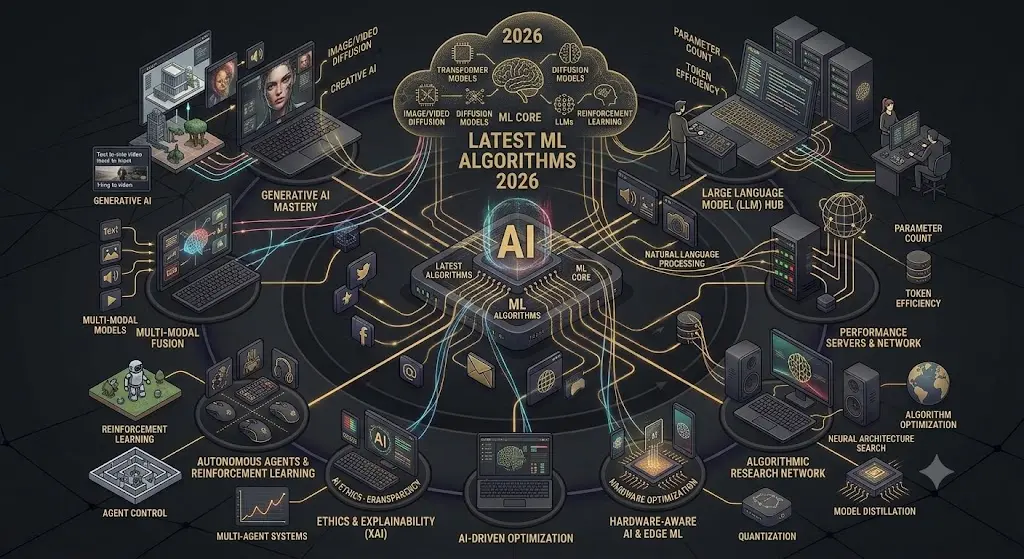
The machine learning sector has recently passed 120 billion. Allow that to sink in. ML has progressed in less than ten years. In the short period of time, it was seen as an academic study of the foundation of the world of business and by 2026, it will no longer be a competitive advantage. It is a need to survive.
This guide is designed to be trusted by whether you are a developer helping you pick your first algorithm, a business leader determining your AI road map, or a curious professional seeking to cut through the noise. We discuss the most recent machine learning algorithms that 2026 has paved the way to the front line, how to select among them and how modern machine learning systems are constructed, deployed and maintained.
What Is Machine Learning in 2026 and Why It Now Powers Everything
Disregard the dictionary explanation. In 2026, machine learning will not be a niche technology; it will be the underlying plumbing of virtually everything you interact with online. It is used by your bank to stop the fraud before you can notice. It is used in the imaging software of your doctor to capture what your human eye may fail to notice. It is used by your streaming platform to determine what you will view next.
In its simplest form, ML is a system that identifies patterns in data and applies the patterns to make decisions – without a programmer writing code to specify all of them. The definition has, however, grown. The current ML stack has more than just supervised and unsupervised models but foundation models, multi modal systems and agentic AI which take multi-step actions in the real world.
The hierarchy in 2026 would be as follows:
Many modern agentic systems are built on top of foundation models, although agentic AI represents a design pattern rather than a separate layer in the hierarchy.
The layers are all specialisations of the layer above. Multi-layered neural networks are employed in deep learning. The foundation models (such as GPT-class or Gemini-class models) are trained on large datasets and scaled to specific tasks. And more so, agentic AI goes a step further, such systems reason, plan and execute a series of actions independently.
The statistics affirm the trend. Out of the top businesses, 92% have invested in ML or AI. US enterprises now consider ML a normal component of IT activities not an R&D initiative 72%. In 2026, the global ML market was estimated to be at $120.32 billion and is expected to reach $1.88 trillion by 2035 with a compound annual growth rate of 35.3% (Research Nester, 2026).
This is not hype. This is what the market is telling you about where the world is heading to.
Five kinds of machine learning you need to know in 2026
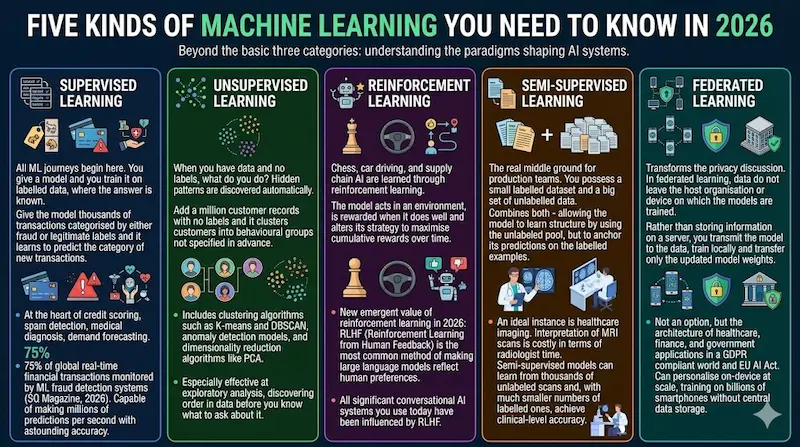
The majority of the guides present you with three categories of machine learning and stop there. No longer is that sufficient. There are five different learning paradigms actively contributing to the construction of AI systems in 2026 – and each of them addresses a different type of problem.
Supervised Learning
All ML journeys begin here. You are given a model and you train it on labelled data, that is, cases in which you already know the answer. Give the model thousands of transactions that are categorised by the label of either fraud or legitimate and it learns to predict the category of a new transaction.
Most production ML systems are currently run by supervised learning. Supervised learning problems are at the heart of credit scoring, spam detection, medical diagnosis, demand forecasting and so on. In the world, 75% of all real-time financial transactions are being monitored by ML fraud detection systems (SQ Magazine, 2026). The scale is made possible by the fact that supervised models are capable of making millions of predictions per second with astounding accuracy.
Unsupervised Learning
When you have data and no labels what do you do? Hidden patterns are discovered automatically in unsupervised learning. Add a million customer records with no labels and it clusters customers into behavioural groups that you never specified in advance.
Such algorithms include clustering algorithms such as K-means and DBSCAN, anomaly detection models and dimensionality reduction algorithms such as PCA. It is especially effective at exploratory analysis, discovering order in data before you know what you want to ask about it: unsupervised learning.
Reinforcement Learning
Chess, car driving and supply chain AI are learned through reinforcement learning. The model acts within an environment, is rewarded when it does well and alters its strategy to maximise the cumulative reward over time.
The new emergent value of reinforcement learning in 2026 is urgent: RLHF (Reinforcement Learning from Human Feedback) is the most common method of making large language models reflect human preferences. All significant conversational AI systems you use today have been influenced by RLHF.
Semi-Supervised Learning
The real middle ground that production teams will work with is this. You possess a small labelled dataset and a big set of unlabelled data. Semi-supervised learning combines both of them – allowing the model to learn structure by using the unlabeled pool, but to anchor its predictions on the labelled examples.
An ideal instance is healthcare imaging. Interpretation of MRI scans is costly in terms of radiologist time. Semi-supervised models can be trained to learn useful representations using thousands of unlabeled scans and with much smaller numbers of labelled ones, can achieve clinical-level accuracy.
Federated Learning
It is this paradigm that transforms the privacy discussion. In federated learning, data do not leave the host organisation or device on which the models are trained. Rather than storing information on a server, you transmit the model to the data, train locally and transfer only the updated model weights.
Federated learning is not an option, but the architecture of healthcare, finance and government applications in a world that is GDPR compliant and compliant with the EU AI Act. It can also be used to personalise on-device at scale, where models are trained on billions of smartphones without a single user’s data ever going to a central server.
Latest Machine Learning Algorithms 2026: A Benchmark Comparison
This is the question that all practitioners ask themselves: you have a problem, you have data, what algorithm do you really use? Most guides acknowledge that the answer is more important than they think. Select the wrong algorithm and you lose months of computer time, engineering time and business reputation.
There is no other guide that presents you with a direct benchmark comparison of the newest machine learning algorithms that 2026 teams are using in production. This table does.
Algorithm Benchmark Table — 2026
| Algorithm | Best task type | Accuracy / AUC | Training speed | Hardware req. | 2026 status |
|---|---|---|---|---|---|
| XGBoost | Tabular classification, regression | 91–94% AUC on credit scoring | Fast (minutes) | Standard CPU | Production standard |
| LightGBM | Large tabular datasets, ranking | Matches XGBoost, 2–3× faster | Very fast | Standard CPU/GPU | High adoption |
| Random Forest | Tabular, interpretable tasks | 88–92% AUC | Moderate | CPU | Mature, widely trusted |
| Transformer (BERT/GPT-class) | NLP, multimodal, reasoning | State-of-the-art on most NLP benchmarks | Slow (hours–days) | High-end GPU/TPU | Dominant for unstructured data |
| CNN / Vision Transformer (ViT) | Image classification, detection | 98.1%+ top-1 accuracy on standard benchmarks | Moderate–slow | GPU required | Production standard for vision |
| Graph Neural Network (GNN) | Relational data, fraud graphs, molecules | Task-dependent; strong on graph-structured data | Moderate | GPU | Growing fast |
| Mamba (State Space Model) | Long sequences, time series, genomics | Competitive with Transformers, lower compute | Fast (vs Transformer) | GPU | Emerging; watch closely |
| Diffusion Models | Generative tasks (images, tabular, molecules) | Best-in-class generative quality | Slow (inference) | High-end GPU | Rapidly expanding |
Key insight from this table: In structured, tabular data, the type of information that most businesses and organisations actually possess, XGBoost and LightGBM remain more accurate and far faster and less expensive than deep learning. Deep learning is competitive on unstructured data (text, images, audio) where automatic learning of representations is unmatched.
In 2025-2026, ML credit scoring models with gradient boosting as the main architecture attained an AUC of 91% (SQ Magazine, 2026). It is no trifle improvement upon the old logistic regression baseline – that is the difference between preventing fraud and detecting it.
Algorithm Selection: A Quick Decision Guide
Ask these questions in order:
Is your data structured/tabular? → Start with XGBoost or LightGBM
Is your data text, images, or audio? → Use a Transformer or CNN
Do you have graph-structured relationships? → Graph Neural Networks
Do you have long time-series sequences? → Try Mamba or LSTM
Are you generating content (images, synthetic data)? → Diffusion Models
Emerging Algorithms to Watch in 2026
Mamba / State Space Models are the most discussed challenger to the Transformer. They also execute long sequences at a linear complexity, as opposed to quadratic complexity and are much more economical to execute on long documents, genomic data and longer time-series. Initial performance indicates competitive performance at a fraction of the cost of computing.
Kolmogorov-Arnold Networks (KAN) reconsiders the basic building block of neural networks. KANs do not have fixed node activation functions: they put learnable functions on the edges. They demonstrate good initial performance on scientific and mathematical activities.
Mixture-of-Experts (MoE) models only activate a small number of parameters at each input, enabling very large models to be computed. MoE is internally used in GPT-4 and Gemini Ultra. This architecture is likely to take over the upcoming generation of foundation models.
Machine Learning Architecture: How Modern ML Systems Are Built in 2026
The simple part is to construct a machine learning model. The last stage at which most projects fail is to build a Machine Learning Architecture that can be relied on in production.
An ML system in production is not a model. It is a chain of interrelated elements, each having to do with a particular layer of the workflow. The distinction between a business-grade AI system and a data science project lies in understanding this architecture.
The Data Pipeline Layer
It all begins with data. Raw Data flows in via an ingestion layer – streaming in via Kafka, batched via data warehouses, or via APIs. Each time a model is presented with a data point, it goes through a feature store: a centralised feature repository that computes, stores and serves features every time a model is presented with a data point between training and serving.
Apache Kafka is a streaming server. Feast and Tecton handle the storage of features. dbt converts raw data in the warehouse into feature-ready models. This layer is not seen by end users, but is catastrophically important – data drift and training-serving skew are more frequently leading to production ML failures than any modelling error.
The Model Training Layer
Training in the modern world is at scale. PyTorch 2.x with torch. Compile is up to 30-40% faster to train, with kernel fusion. Multi-GPU distributed training involves frameworks such as DeepSpeed or FSDP to divide models that are no longer able to be run on a single card.
One of the actual trade-offs is the cloud vs on-premise choice. In 2026, 53.1% of ML deployments used cloud infrastructure, which is fueled by flexibility and controlled tooling (Fortune Business Insights, 2026). However, on-premise GPU clusters have less latency and complete data sovereignty, which are essential to healthcare and finance applications that are the subject of intense regulatory scrutiny.
The Serving and Inference Layer
Only in the case of a trained model are the values delivered. Serving architecture encases the model within a REST or gRPC API, performs batching to support throughput and provides versioning to make rolling back to a prior model available in minutes.
ONNX runtime offers a hardware-neutral inference format, PyTorch training, ONNX export and serving on any hardware. TensorFlow Serving and Triton Inference Server are used to serve high-throughput production. To run efficient TensorFlow Lite and Core ML compressed models on phones and embedded systems, edge devices are required.
The Monitoring and Feedback Loop
It is the level that most groups omit – and why most ML projects decay silently with time. Models cannot fail catastrophically. They drift. The world is varying, the data is varying and the predictions made by the model turn out to be less precise over time without causing a clearly apparent mistake.
Such tools as Evidently AI, Arize and Whylogs track the distributions of data in production and indicate the existence of statistical drift and automatically initiate retraining pipelines. The reason is that in 2026 large enterprises occupy 55.6% of the ML market due to their ability to invest in the infrastructure of MLOps that ensures models maintain the accuracy they have at the time of deployment.
Deep Learning in 2026: Neural Networks, Transformers and What Comes Next
Deep learning is no longer a secret. The technology is what drives all of the amazing AI features you have interacted with in the past five years and in 2026, it is going through its second big architectural transformation.
CNN vs RNN vs Transformer: A Practical Comparison
| Architecture | Strength | Weakness | Best use case in 2026 |
|---|---|---|---|
| CNN | Spatial pattern recognition, speed | Poor at sequential reasoning | Image classification, video, medical imaging |
| RNN / LSTM | Sequential data, temporal patterns | Slow to train, limited context | Legacy time-series, some NLP tasks |
| Transformer | Attention across long contexts, parallelisable | Quadratic compute cost, large memory | NLP, multimodal AI, reasoning tasks |
| Mamba / SSM | Long sequences, efficient compute | Less proven, smaller ecosystem | Genomics, long documents, time-series |
Transformer Dominance in 2026
Transformer architecture, first released in 2017, is now the most popular architecture in nearly all tasks on unstructured data. Its primary innovation, the attention mechanism, allows the model to comparatively rank the significance of each input token against the rest of the tokens concurrently. This is the reason why GPT-type models are capable of maintaining consistent context in thousands of words.
Transformers power multimodal AI: models that use images and text jointly, producing captions, answering image-related questions and creating visual content based on language prompts in 2026. In 2025-2026, big vision-language models achieved an average top-5 accuracy of 97.3% (SQ Magazine, 2026). The latest models of object detectors can now reach 70 frames per second on edge devices – a rate that would have been unattainable only three years ago.
What Comes After the Transformer?
Transformers are weak in one aspect: they do not scale well to very long sequences, as they are quadratically sensitive to sequence length. It is exponentially more costly to process a 100,000-word document than a 1,000-word document.
Mamba deals with this through a linearly scaling state-space architecture. Initial results indicate that Mamba is as fast as Transformer on language tasks with a small portion of the memory for long sequences. It is not the replacement but the most believable opponent that Transformer has ever had.
Mixture-of-Experts does it in a different way: rather than computing all the inputs with all the neurons, MoE forwards each input token to a small group of specialist sub-networks. The outcome is a billion-parameter model which computes computationally, in a way similar to a much smaller model. This is the architecture powering the next generation of foundation models.
Machine Learning in the Real World: 2026 Use Cases with Measurable Results
Theory is clean. The world is complex, costly and politically convoluted. It is here that ML is already producing quantifiable results at this time – not in five years.
Healthcare: Diagnostics That Save Lives
Medical imaging machine learning is no longer a pilot project. ML diagnostic systems process radiology scans, pathology slide images and retinal images with the same accuracy as and in some tasks, better than, expert physicians. In the US, healthcare ML applications increased by 34%/year, with imaging diagnostics and personalised treatment planning being the most common (SQ Magazine, 2026).
The real-world effect: earlier diagnosis of cancers, diabetic retinopathy and neurological diseases. Quick diagnosis in low-resource hospitals where waiting periods for specialists take months.
Finance: Fraud Prevention at Machine Speed
A million transactions a second cannot be reviewed by a human team. ML systems are able to – and they do. Gradient boosting and neural network-based fraud detection models now screen three-quarters of the real-time financial transactions in the world. By 2026, credit scoring models achieved 91% AUC performance, significantly decreasing false positives that had in the past denied legitimate customers borrowing opportunities.
The second advantage is no less important: quicker approvals. Decisions that would take days to be made now take milliseconds to be made when the model is sure.
Retail and E-Commerce: Knowing What Customers Want Before They Do
Currently, 57% of companies use ML to enhance the consumer experience (DemandSage, 2026). Examples of common ML applications in large retail businesses include recommendation engines, dynamic pricing, inventory optimisation and return fraud detection.
The ROI is properly documented. Customised suggestion engines generate 30-40% of the income in the biggest e-commerce sites. Competitor price changes and demand signals are responded to more quickly than any human pricing team by dynamic pricing models.
Manufacturing: Eliminating Downtime Before It Happens
One of the most obvious value propositions of ML is predictive maintenance. Industrial equipment has sensors that feed vibration, temperature and pressure data in real time. ML models that have learned failure modes in the past identify anomalies weeks ahead of a failure happening, which minimises the amount of unplanned downtime in deployments with established data infrastructure by 20% to 30%
Responsible AI in 2026: Explainability, Ethics and the EU AI Act
Gone are the days when everyone should trust the model. Regulators, auditors and customers now insist on not only knowing what your model predicts – but why.
Explainable AI (XAI): Opening the Black Box
Explainable AI is a set of methods that enable the interpretation of model predictions by humans. SHAP (SHapley Additive explanations) and LIME (Local Interpretable Model-agnostic Explanations) are the two most popular methods deployed in 2026.
SHAP attaches a numerical value to the input features in order to determine their contribution to a particular prediction. When your credit model rejects a loan to someone, SHAP will tell you (and the customer) which factors caused the rejection. An answer that a regulator can audit is “Your debt-to-income ratio contributed +0.34 to the denial score. No means no in the model.
LIME is complementary: it constructs a local model that is simple and interpretable around each individual prediction, which is an approximation of what the complex model is doing in that area of the input space.
The EU AI Act: What It Means for ML Teams Right Now
The EU AI Act was implemented in phases until 2024-2025 and is currently in operation. It categorises AI systems by risk, with high-risk applications, such as hiring, credit scoring, medical diagnosis, biometric identification, required to have transparency, bias auditing and human oversight systems.
When your ML system makes decisions about people, rights and access to services or livelihoods, you now require documented model cards, bias impact assessments and audit trails of training data. Failure to comply is fined at a maximum of 3% of annual worldwide earnings.
Bias Detection: Building Fair Models from the Start
Fairness is not a byword; it is an architectural choice. Such tools as Microsoft Fairlearn and IBM AIF360 calculate metrics of fairness such as demographic parity (do true acceptance rates vary according to demographic group?) and equalised odds (do true positive rates vary?). It is much more economical to prevent and rectify bias in development than a discriminatory deployment would be in terms of legal liability and reputational damage.
Edge Machine Learning: Running AI Models On-Device in 2026
The most rapid ML inference is one that does not exit the device. Edge machine learning executes models on phones, cameras, industrial sensors and embedded systems themselves, removing the cost in latency and privacy of round-trips to the cloud.
The story is conveyed by the performance numbers. The latest object detection models are capable of running at more than 70 frames per second on edge hardware in 2026 (SQ Magazine, 2026). On-device results of speech-to-text models are less than 4% word error rate on standard English – results that two years ago were only available in the cloud.
The software enabling this is TensorFlow Lite and Core ML to deploy to mobile devices, ONNX runtime to ensure compatibility across platforms and MediaPipe to perform real-time streaming ML applications, such as face detection and pose detection. Quantisation, pruning and knowledge distillation are model compression methods that reduce the size of multi-gigabyte models to a few megabytes without significant loss in accuracy.
The applications are growing at a rapid pace. Personalised anomaly detection on the wrist is performed using wearable health monitors. The smart factory cameras identify defects at production-line speed and do not need a network connection. Smartphones are audio recorders, meeting books, translators and creators of content all on the phone.
Healthcare and finance have a strong case for privacy: the data of patients does not go outside the hospital network. The data of transactions does not leave the bank infrastructure. The architecture of a privacy-first AI future is composed of edge inference and federated learning.
Starting Your AI Machine Learning Development Journey in 2026
The development of AI machine learning has never been as accessible or as filled with crowds. The learning curve is an actual phenomenon but the direction has become clearer than ever. Herein, an organised roadmap that will bring you to a production-ready.
The 2026 Learning Path
Stage 1: Foundations (4-6 weeks): Python 3.12 basics. NumPy and Pandas to manipulate data. Seaborn and Matplotlib to visualise. Do not overlook this step – poor data handling abilities will make your next step slower at every step.
Stage 2: Classical ML (6-8 weeks): Scikit-learn supervised and unsupervised models. Train initial classification and regression. Get familiar with cross-validation, tuning of hyperparameters and the bias-variance trade-off. Create an entire pipeline from raw data to deployed prediction.
Stage 3: Deep Learning (8-12 weeks): The research and production in 2026 focus on PyTorch 2.x. Get familiar with tensor operations, autograd and the training loop. Create CNNs to perform image tasks and fine-tune a pre-trained Transformer model to perform NLP tasks, using Hugging Face.
Stage 4: MLflow (4-6 weeks): MLflow to track experiments and model versioning. FastAPI to wrap models as REST APIs. Docker for containerisation. CI/CD pipeline GitHub Actions. This is where the difference between data scientists who can create models and engineers who can implement them in a dependable manner lies.
The 2026 Production Stack
- Language: Python 3.12
- Data: Pandas, Polars (for large datasets), DuckDB
- ML: Scikit-learn, XGBoost, LightGBM
- Deep Learning: PyTorch 2.x, Hugging Face Transformers
- Experiment tracking: MLflow, Weights & Biases
- Serving: FastAPI, Triton Inference Server
- Monitoring: Evidently AI, Arize
- Orchestration: Apache Airflow or Prefect
The opportunity is big. One out of every three US companies has already switched to ML and two out of three are in the process of considering it (DemandSage, 2026). That 42% is such a large number of organisations that require trained ML practitioners today, not in three years.
Frequently Asked Questions About Machine Learning in 2026
Which machine learning algorithms will be most popular in 2026? XGBoost and LightGBM are the most commonly deployed algorithms on structured, tabular data – the type most businesses possess. Transformer-based architectures are predominant in unstructured data (text, images, audio). New competitors are Mamba to do long sequence tasks and Mixture-of-Experts to do large-scale foundation models.
What is machine learning vs deep learning? The larger field is machine learning: any data-driven system. The particular subdivision that makes use of multi-layered neural networks is called deep learning. All deep learning is machine learning, but most machine learning particularly on structured business data, does not use deep learning. In the case of tabular data, gradient boosting is usually more accurate and efficient than deep learning.
What will be the optimal machine learning architecture in 2026? PyTorch 2.x is the most popular deep learning research and production framework. Scikit-learn is still the standard of classical ML. When dealing with large-scale data processing, Polars is quickly supplanting Pandas in performance-critical pipelines. FastAPI and ONNX runtime support most production serving applications to be deployed.
What is Machine Learning Architecture? Machine Learning Architecture is a description of the end-to-end system design of a production ML application – including data ingestion and feature engineering, model training and validation, serving, monitoring and retraining. An effective ML architecture can guarantee that models provide reliable and consistent predictions at scale and gracefully degrade when data distributions change with time.
What is the difference between machine learning and AI? No, machine learning is a part of AI. The general aim of creating intelligent behaviour in systems is artificial intelligence. One method of attaining that objective is machine learning, where systems learn through data. Other AI strategies are rule-based systems, symbolic reasoning and search algorithms. Nowadays, however, the term AI most often applies to ML-based systems.
Conclusion: Machine Learning in 2026 Is Infrastructure, Not Innovation
The discussion has changed. Three years ago, you were ahead of the curve when building an ML system. Nowadays, 92% of the top businesses have invested in ML or AI. The industry is at $120 billion and it is gaining momentum. The companies that continue to consider ML a future project are creating a divide that is increasingly costly to bridge with each quarter.
The most recent machine learning models in 2026 – whether it is the still-dominant performance of XGBoost on structured data, or the ability of transformers to redefine what can be done with language and vision, or the status quo challenge of Mamba on sequence modelling – provide a more diverse, more powerful set of tools than has ever been available to the practitioner.
Know your data. Select the appropriate algorithm for the appropriate problem. Design structures to make models honest in production. Embark on explainability early. And begin when you are not in readiness since the teams already in action are learning more rapidly than those on the sidelines.